Have you ever paused mid-sentence, wondering “Am I using this word correctly?” You’re not alone. One of the most commonly confused words in English is whether.
Understanding the whether meaning is essential for clear communication, confident writing, and polished speech. ✨
In this in-depth guide, we’ll explore the meaning of whether from every angle—its definition, origin, grammar rules, examples, and common mistakes. By the end, you’ll not only understand what whether means, but you’ll also know exactly how and when to use it like an expert. 💡
What Is the Meaning of Whether? 📘
At its core, the whether meaning relates to expressing a choice, doubt, or alternative. The word whether is a conjunction used to introduce possibilities or options, often involving two or more outcomes.
In simple terms, whether means:
- If something is true or not
- Which of two (or more) possibilities will happen
- Regardless of the outcome
Example:
I don’t know whether she will come today.
Here, whether introduces uncertainty about an outcome.
Why Understanding Whether Meaning Matters 🧠
Knowing the correct whether meaning improves:
- ✅ Writing clarity
- ✅ Grammar accuracy
- ✅ Professional communication
- ✅ Academic performance
Misusing whether can confuse readers and weaken your message. That’s why mastering it is more important than you might think. 🎯
The Origin and History of the Word Whether 🕰️
The word whether comes from Old English hwæðer, meaning “which of two”. Over time, its usage expanded beyond just two choices to include broader uncertainty and conditional situations.
Understanding this origin helps explain why whether is often used when alternatives are implied—even if they aren’t directly stated.
Whether Meaning in Grammar (Expert Explanation) ✍️
Grammatically, whether functions as a subordinating conjunction. It connects a dependent clause to a main clause, usually expressing doubt or alternatives.
Structure example:
Main clause + whether + dependent clause
Example:
She asked whether the meeting was canceled.
Whether vs If: Understanding the Difference ⚖️
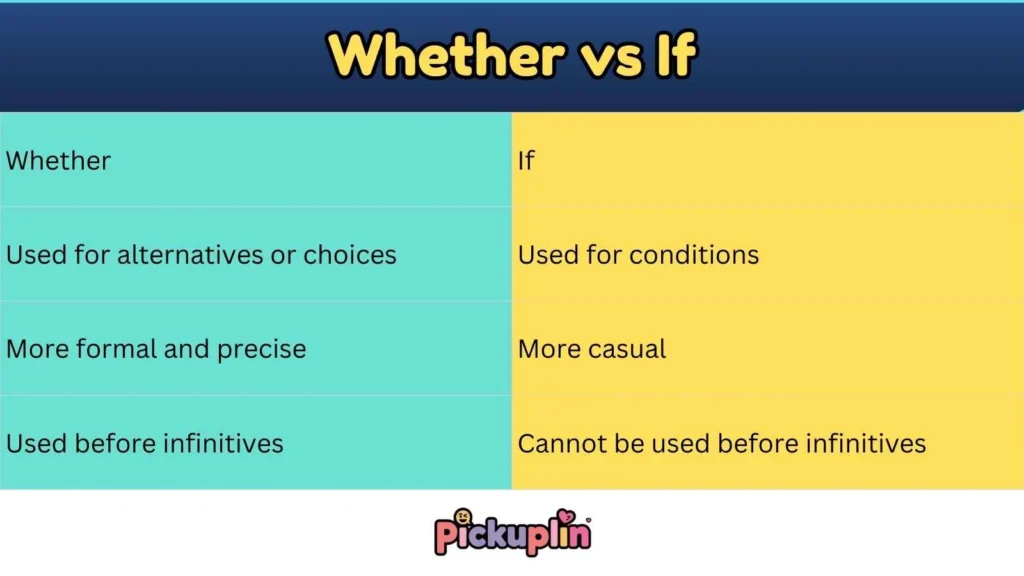
One of the biggest sources of confusion is choosing between whether and if. While they are sometimes interchangeable, they are not always the same.
| Whether | If |
|---|---|
| Used for alternatives or choices | Used for conditions |
| More formal and precise | More casual |
| Used before infinitives | Cannot be used before infinitives |
Correct usage:
- Correct: I don’t know whether to laugh or cry.
- Incorrect: I don’t know if to laugh or cry.
Whether vs Weather: Don’t Mix Them Up 🌦️
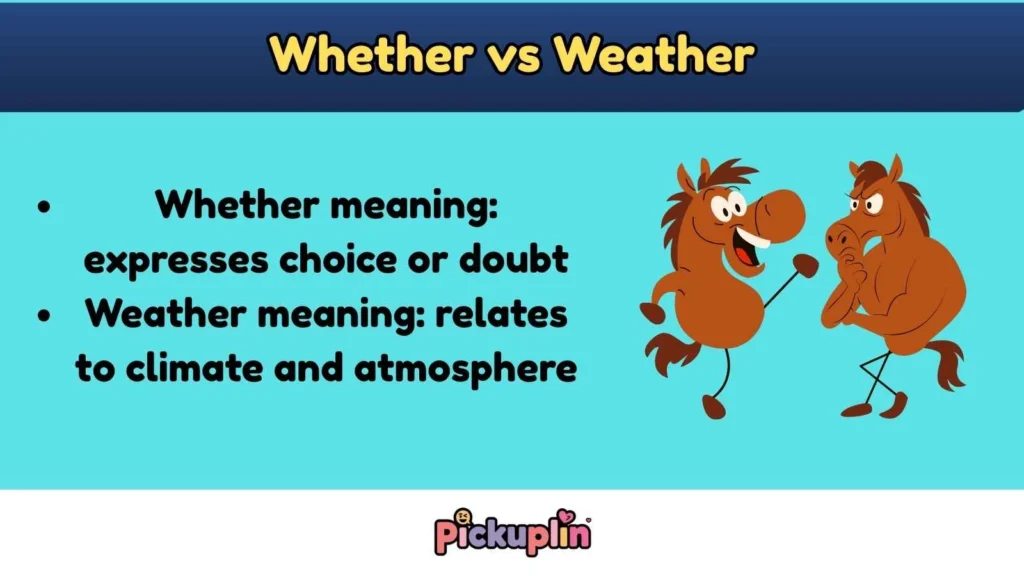
Another common mistake is confusing whether with weather. Despite similar pronunciation, their meanings are completely different.
- Whether meaning: expresses choice or doubt
- Weather meaning: relates to climate and atmosphere
Example:
I’m unsure whether it will rain. ☔
Common Sentence Examples Using Whether 📝
Here are real-life examples to help reinforce the whether meaning:
- She couldn’t decide whether to stay or leave.
- He asked whether the store was open.
- They debated whether the plan would work.
- I wonder whether she remembers me.
Using Whether with “Or Not” 🔄
Often, whether is followed by or not to emphasize alternatives.
Please let me know whether or not you agree.
Interestingly, or not is sometimes implied and doesn’t need to be stated.
Whether in Formal and Academic Writing 🎓
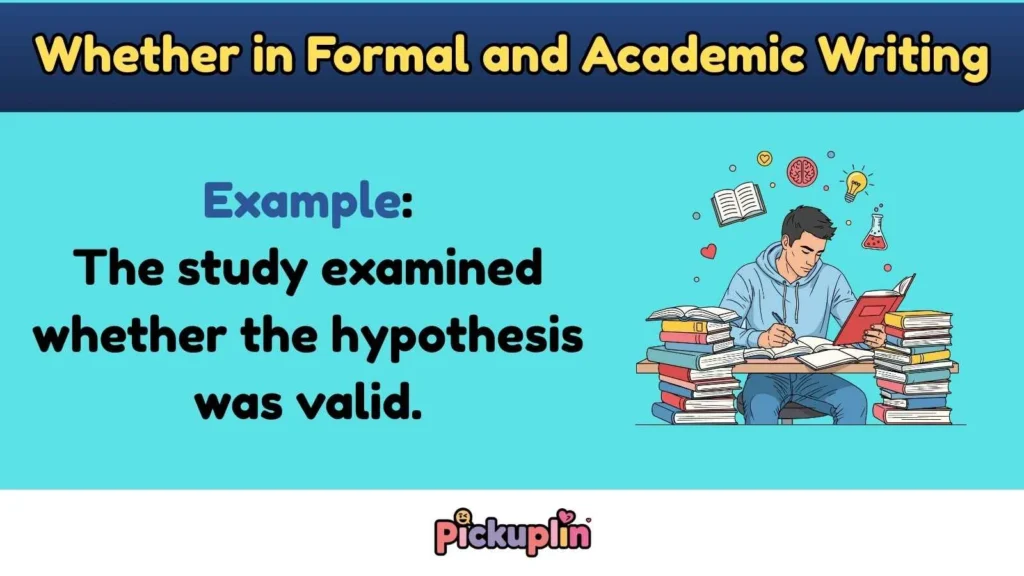
In professional and academic contexts, whether is preferred over if because it sounds more precise and authoritative.
Example:
The study examined whether the hypothesis was valid.
Whether Meaning in Questions ❓
Indirect questions often rely on whether.
Example:
She asked whether he was coming.
This structure is essential for polite and formal communication.
Common Mistakes to Avoid 🚫
- ❌ Using if before an infinitive
- ❌ Confusing whether with weather
- ❌ Overusing whether when not needed
Correcting these mistakes instantly improves your English fluency. 🌟
Whether Meaning Explained for Beginners 👶
If you’re just starting out, remember this:
Use whether when you’re talking about choices or uncertainty.
That one rule will take you a long way.
FAQs
1. What is the simple meaning of whether?
The simple whether meaning is “if something is true or which option will happen.”
2. Can whether and if be used interchangeably?
Sometimes, yes—but not always. Whether is more precise, especially when alternatives are involved.
3. Is whether formal or informal?
Whether is considered more formal and is commonly used in academic and professional writing.
4. Can a sentence start with whether?
Yes, especially in formal or literary writing, though it’s less common in casual speech.
Final Thoughts:
Understanding the whether meaning is a small change that makes a big difference. It sharpens your grammar, boosts your confidence, and helps you communicate with clarity and precision. 💬
Whether you’re writing an essay, sending a professional email, or simply improving your English, this word deserves your attention.

I’m the voice behind Pikuplin, where I simplify meanings, slang, and everyday expressions in a way that actually makes sense. I love breaking down words and phrases so readers can understand not just the definition, but the real meaning behind them. Every piece I write is based on clarity, curiosity, and real human understanding.