Have you ever received a message that simply said “mk” and wondered, “What does this even mean?” 😅 You’re not alone! In the fast-paced world of texting and social media, abbreviations like MK pop up everywhere.
Understanding them can save you from confusion and help you communicate like a pro. In this guide, we’ll explore the meaning, origin, usage, and real-life examples of MK in text.
📌 What Is MK in Text?
The abbreviation MK is a shorthand commonly used in texting, chats, and online messaging. At its core, it represents a casual way of acknowledging or confirming something.
- Primary Meaning: “Okay” or “Alright” ✔️
- Tone: Neutral, casual, sometimes slightly blunt
- Usage: Often used to confirm plans, messages, or instructions
🧐 Origin of MK
The abbreviation MK comes from the first letters of the word “Okay” or its variations. It became popular with the rise of texting, instant messaging, and chat apps where brevity is key. Think of it as a shorthand that saves time while maintaining the essence of acknowledgment. ⏱️
💬 MK vs OK: Are They the Same?
While MK is often used interchangeably with OK, there are subtle differences:
| Term | Meaning | Tone |
|---|---|---|
| MK | Okay / Alright | Casual, sometimes neutral |
| OK | Okay / Confirm | Neutral, formal or casual |
💡 Pro Tip: Using MK can sound slightly less enthusiastic than OK, so context matters!
📈 Why People Use MK in Texts
- Quick Response: Saves typing time, perfect for fast conversations ⏩
- Neutral Confirmation: Doesn’t add extra emotion, keeps it simple 😎
- Texting Culture: Common among younger audiences and social media users 📱
- Platform-Friendly: Works on chat apps like WhatsApp, Messenger, Discord, and SMS ✉️
📚 Real-Life Examples of MK in Text
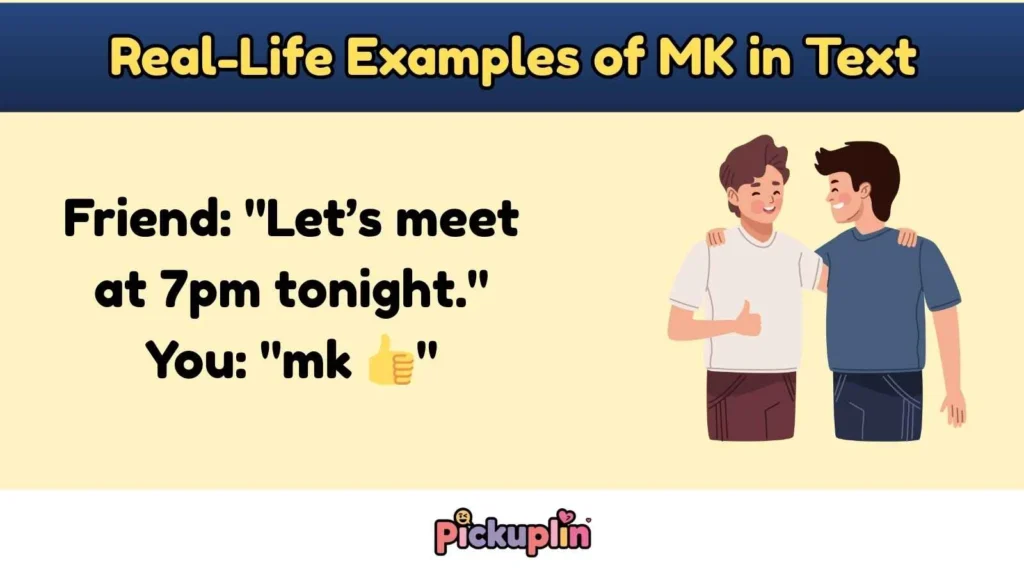
Here are some examples of how MK is used in conversations:
-
Friend: “Let’s meet at 7pm tonight.”
You: “mk 👍” -
Colleague: “Send the report by 5.”
You: “mk, will do” -
Social Media: “Check out this link.”
You: “mk, thanks!”
🧠 MK in Different Contexts
The meaning of MK can slightly change depending on the context:
- Friendly Chat: Light, casual acknowledgment 😄
- Professional Messaging: Neutral, concise confirmation 📝
- Arguments or Tension: Can feel dismissive or indifferent 😐
🤔 Common Misunderstandings About MK
Some people may misinterpret MK due to its brevity. Here are a few things to note:
- Not Rude by Default: It’s usually neutral, not offensive ❌
- Not Always Enthusiastic: Can feel a bit cold depending on tone 🥶
- Regional Differences: Some countries or cultures may not commonly use it 🌍
📱 MK in Social Media and Online Culture
With platforms like Instagram, Snapchat, TikTok, and Discord, MK has become more prevalent:
- Used in DMs and replies as a short acknowledgment ✅
- Common in memes or casual threads for quick responses 😂
- Often paired with emojis to add tone, e.g., “mk 😅” or “mk 👍”
📝 How to Use MK Properly in Texting
Here’s a practical guide to using MK without confusion:
- Use when confirming plans or instructions
- Add an emoji if you want to show friendliness or emotion 😎
- Avoid in formal emails or professional contexts unless tone is casual
- Don’t overuse—it can feel lazy or uninterested if repeated too often
📊 MK Variations You Should Know
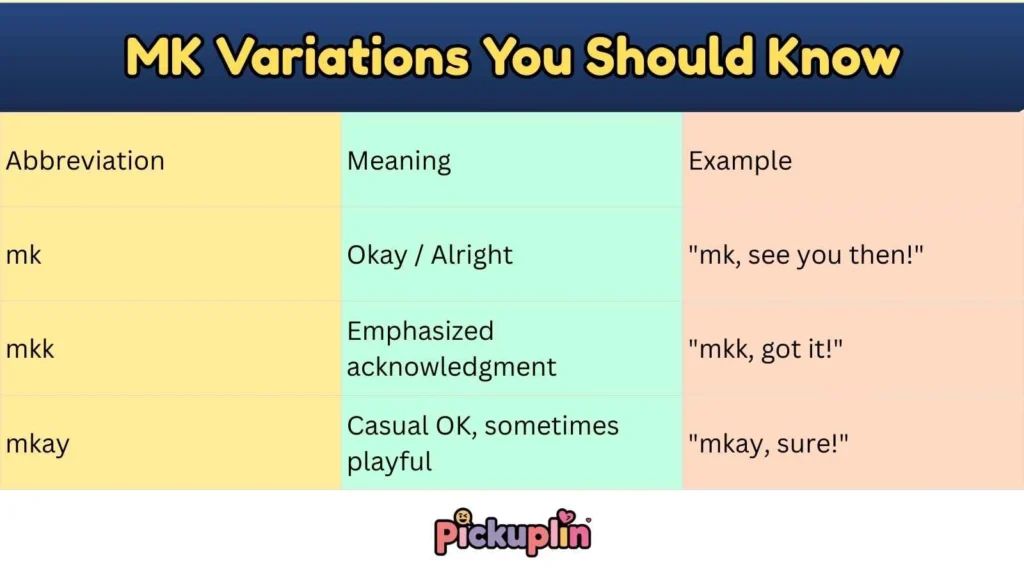
While MK is standard, there are a few variations depending on style and context:
| Abbreviation | Meaning | Example |
|---|---|---|
| mk | Okay / Alright | “mk, see you then!” |
| mkk | Emphasized acknowledgment | “mkk, got it!” |
| mkay | Casual OK, sometimes playful | “mkay, sure!” |
💡 Tips for Reading MK in Text
- Check the context—friendship vs. professional conversation
- Notice accompanying emojis to understand tone 😁 😐 😅
- Consider the person’s usual texting style
- Use your intuition: brevity often signals casual acknowledgment
🗣️ MK in Pop Culture
Over time, MK has appeared in memes, TV shows, and online forums. Its casual vibe fits perfectly with internet culture, making it one of the most recognized texting abbreviations among Gen Z and Millennials alike. 🌐
⚡ Fun Facts About MK
- It’s faster to type than “okay” or “ok”—saves precious seconds in fast chats ⏱️
- Used worldwide, but popularity varies by region 🌎
- It can subtly express indifference without being rude 😏
🛑 Mistakes to Avoid With MK
- Using MK in formal emails or professional settings without context ❌
- Sending MK without tone indicators, which can confuse the recipient 😶
- Overusing MK in a single conversation—it can seem lazy or uninterested 💤
FAQs
1. Is MK rude to use?
No! MK is typically neutral. Tone matters, though; adding emojis can help convey friendliness. 😊
2. Can MK replace OK in professional messages?
Only in casual work chats. For formal emails, stick to “OK” or “Understood.” 📝
3. Are there alternatives to MK?
Yes! Common alternatives include “ok,” “k,” “mkk,” or “mkay,” depending on tone and context. 👍
4. Why do people use MK instead of OK?
MK is shorter, faster to type, and fits texting culture. It’s a quick acknowledgment without extra effort. ⏩
5. Is MK popular worldwide?
It’s more popular in English-speaking countries but understood globally in casual online contexts. 🌍
Conclusion:
MK is a versatile texting abbreviation that stands for “okay” or “alright”. It’s casual, neutral, and widely used in online conversations.
Understanding its tone and context ensures smooth communication, whether with friends, colleagues, or social media communities. Remember to use emojis and context cues for clarity! 😄
Keep MK in your texting toolkit for quick, effortless replies, and stay updated with other texting abbreviations to communicate like a pro! 🚀

I’m the voice behind Pikuplin, where I simplify meanings, slang, and everyday expressions in a way that actually makes sense. I love breaking down words and phrases so readers can understand not just the definition, but the real meaning behind them. Every piece I write is based on clarity, curiosity, and real human understanding.