
Have you ever come across the word unprecedented and wondered why it carries such weight in conversations, news, or literature? 🤔
In a world that’s constantly evolving, understanding the true meaning of “unprecedented” is more important than ever.
This word isn’t just a fancy adjective—it conveys something extraordinary, unparalleled, and historic.
we’ll dive deep into its meaning, origin, examples, and practical uses so you can wield it with confidence in your writing and speech. 🚀
What Does “Unprecedented” Mean? 📖
The term unprecedented refers to something that has never happened before or has no prior example. It describes situations, events, or actions that are entirely new, extraordinary, and unmatched in history. 🌍
For example:
- “The city faced unprecedented flooding after the storm.” 🌧️
- “Her achievements in science are truly unprecedented.” 🧬
In simple words, if something is unprecedented, it’s unique and without prior comparison.
Origin and History of “Unprecedented” ⏳
The word unprecedented originates from the Latin praecedere (to go before). The prefix un- means “not,” so it literally translates to “never gone before”. 🏛️
Historically, it began appearing in English texts around the 16th century to describe events or actions that were novel or without prior example. Over time, it became a staple in both formal and casual language, especially in journalism, literature, and legal contexts. 📜
Synonyms and Related Words 📝
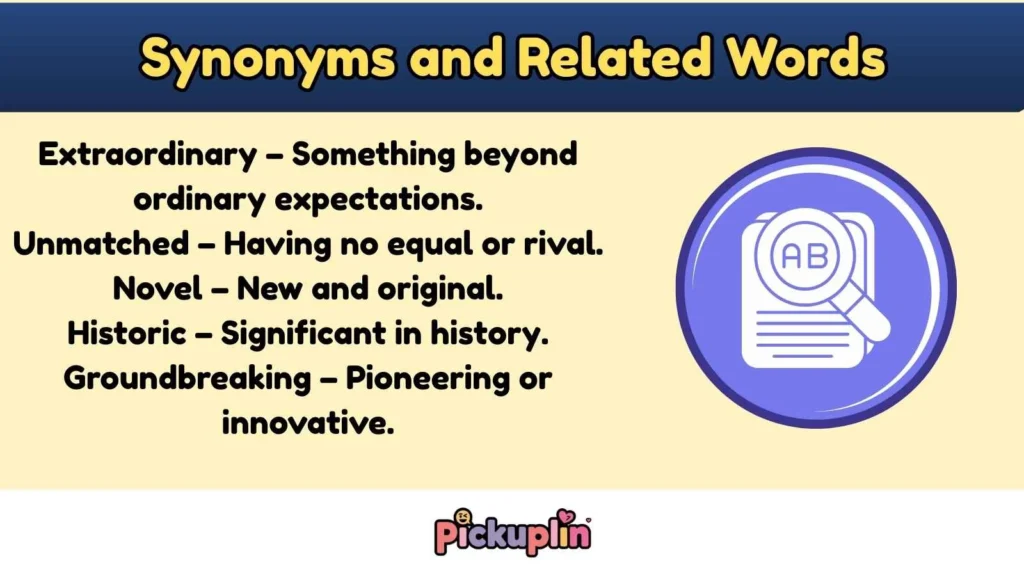
Understanding synonyms helps you use the word more effectively in different contexts. Here are some common alternatives:
- Extraordinary – Something beyond ordinary expectations.
- Unmatched – Having no equal or rival.
- Novel – New and original.
- Historic – Significant in history.
- Groundbreaking – Pioneering or innovative.
Practical Examples of “Unprecedented” in Sentences ✨
| Context | Sentence Example |
|---|---|
| Natural Events | “The region experienced unprecedented snowfall this winter.” ❄️ |
| Business | “The company reported unprecedented growth in the last quarter.” 📈 |
| Personal Achievement | “Winning three gold medals in a row was unprecedented in her career.” 🏅 |
| Historical Events | “The treaty marked an unprecedented alliance between nations.” 🌐 |
Why Using “Unprecedented” Matters in Writing ✍️
Using the word unprecedented can make your writing more impactful because it conveys:
- Significance: Shows importance of the event or action.
- Uniqueness: Highlights originality or rarity.
- Emphasis: Adds weight to your argument or story.
For example, journalists often write, “The pandemic caused unprecedented challenges,” to stress the historic nature of the situation. 📰
Common Mistakes When Using “Unprecedented” ❌
Even experts misuse “unprecedented” at times. Avoid these pitfalls:
- Using it for minor or common events. ✋ Example: “I had an unprecedented sandwich for lunch.” ❌
- Overusing it in a single article or speech. 🔄
- Confusing it with “unexpected.” ⚠️ Remember: Something can be unexpected but not unprecedented.
Unprecedented vs. Similar Words: Quick Comparison 🔍
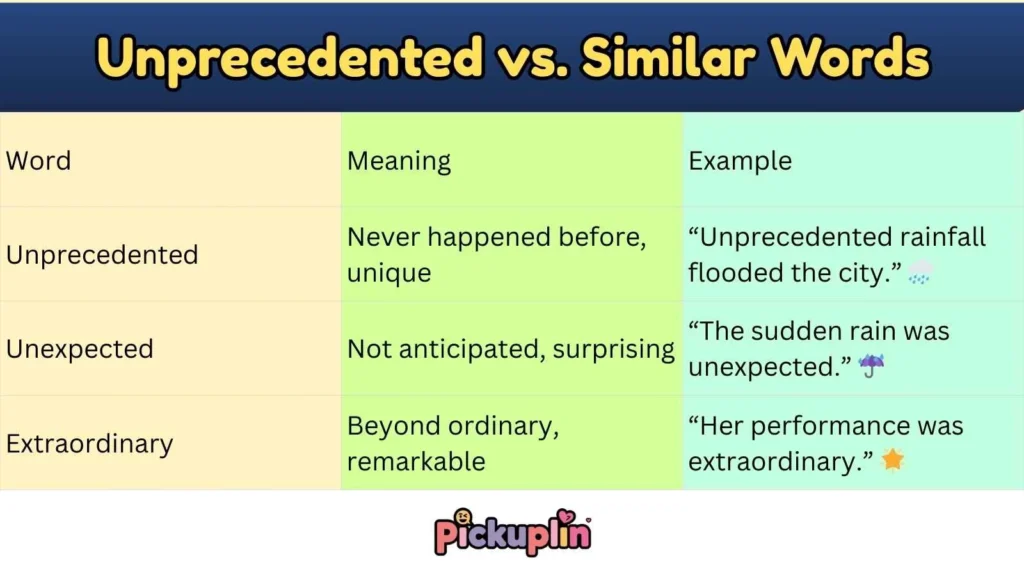
| Word | Meaning | Example |
|---|---|---|
| Unprecedented | Never happened before, unique | “Unprecedented rainfall flooded the city.” 🌧️ |
| Unexpected | Not anticipated, surprising | “The sudden rain was unexpected.” ☔ |
| Extraordinary | Beyond ordinary, remarkable | “Her performance was extraordinary.” 🌟 |
Why “Unprecedented” Is a Powerful Word in Communication 💬
“Unprecedented” captures attention instantly. It signals to the reader or listener that something historic or unusual is happening. In journalism, marketing, and storytelling, this word evokes curiosity, urgency, and respect. ⚡
Unprecedented Events in History 🌍
Here are a few examples of truly unprecedented historical events:
- Moon Landing (1969): Humanity stepped on the moon for the first time. 🌕
- Fall of the Berlin Wall (1989): Symbolized a unique political change. 🧱
- Global Pandemic (2020): COVID-19 created unprecedented health and economic challenges. 🦠
Tips for Using “Unprecedented” in Your Writing ✍️
Follow these tips to use the word effectively:
- Use it for significant or rare events only. ✅
- Pair it with strong adjectives or examples for emphasis. 💪
- Avoid exaggeration; credibility is key. 🏅
- Integrate it naturally into your sentences. 🌿
- Use synonyms sparingly to maintain freshness. 🔄
Unprecedented in Business and Technology 🚀
In the business world, the word highlights innovation, risk, and growth:
- “The launch of AI-powered tools caused unprecedented disruption in the market.” 🤖
- “Customer demand for sustainable products reached unprecedented levels.” 🌱
Emotional Impact of “Unprecedented” ❤️
Using the word evokes emotions such as awe, surprise, urgency, or admiration. Writers and speakers choose it to:
- Highlight the magnitude of events 🌊
- Encourage action or attention ⚡
- Inspire wonder or motivation ✨
Unprecedented in Everyday Life 🌟
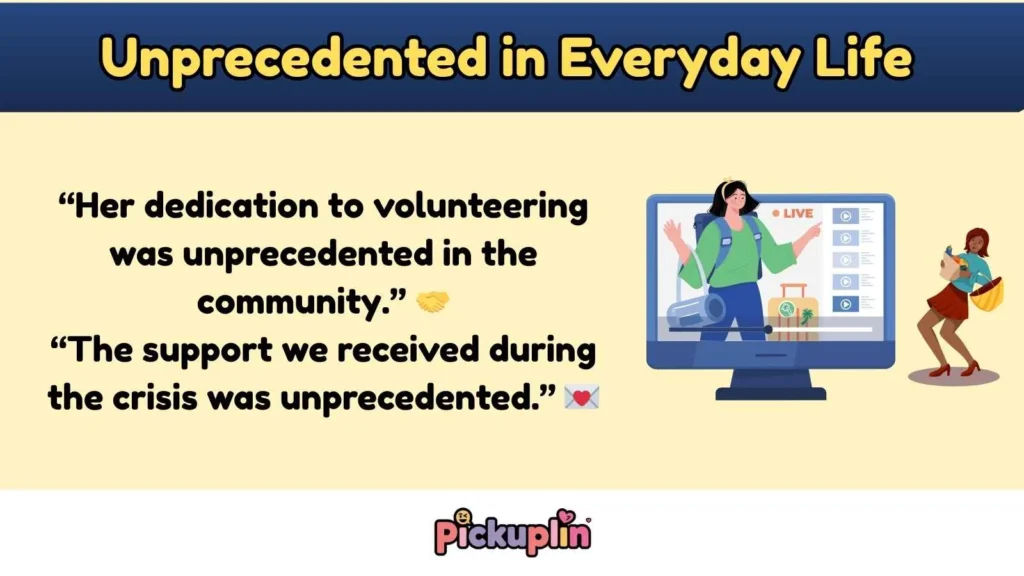
Even outside of history or news, the word can describe personal achievements or life experiences:
- “Her dedication to volunteering was unprecedented in the community.” 🤝
- “The support we received during the crisis was unprecedented.” 💌
Quotes Featuring “Unprecedented” 🗣️
“We are living in unprecedented times, and it calls for unprecedented solutions.” – Anonymous
“Innovation often arises from unprecedented challenges.” – Business Expert
Tips to Remember “Unprecedented” Easily 🧠
Think of it as:
- Un- = not
- Precedent = a prior example
- Combine them → no prior example ever exists ✅
FAQs
1. Is “unprecedented” always positive?
No, it can be positive, negative, or neutral depending on context. Example: “Unprecedented success” vs. “unprecedented crisis.”
2. Can I use “unprecedented” for small events?
It’s best for significant or historic events. Using it for minor things may seem exaggerated.
3. How do I pronounce “unprecedented”?
It’s pronounced: /ʌnˈprɛs.ɪ.den.tɪd/ ✅
4. What is the difference between unprecedented and extraordinary?
Extraordinary emphasizes being remarkable; unprecedented emphasizes never happening before.
5. Can I use it in business reports?
Absolutely. It’s often used to highlight unusual growth, challenges, or achievements. Example: “The company achieved unprecedented revenue this quarter.”
Conclusion:
The word unprecedented is more than just a fancy adjective—it’s a tool to communicate rarity, importance, and impact.
From historical events to personal achievements, using it thoughtfully adds weight and credibility to your writing.
Remember, its power lies in its accuracy and context. 🌟

I’m the voice behind Pikuplin, where I simplify meanings, slang, and everyday expressions in a way that actually makes sense. I love breaking down words and phrases so readers can understand not just the definition, but the real meaning behind them. Every piece I write is based on clarity, curiosity, and real human understanding.