Have you ever heard someone say something was tentative and wondered exactly what it meant? 🤔 Whether it’s in school, work, or casual conversations, the word “tentative” often pops up to describe situations, decisions, or plans that aren’t fully confirmed.
In this article, we’ll dive deep into the tentative meaning, explore its origins, provide clear examples, and show you how to use it confidently in your daily life.
📌 What Does Tentative Mean?
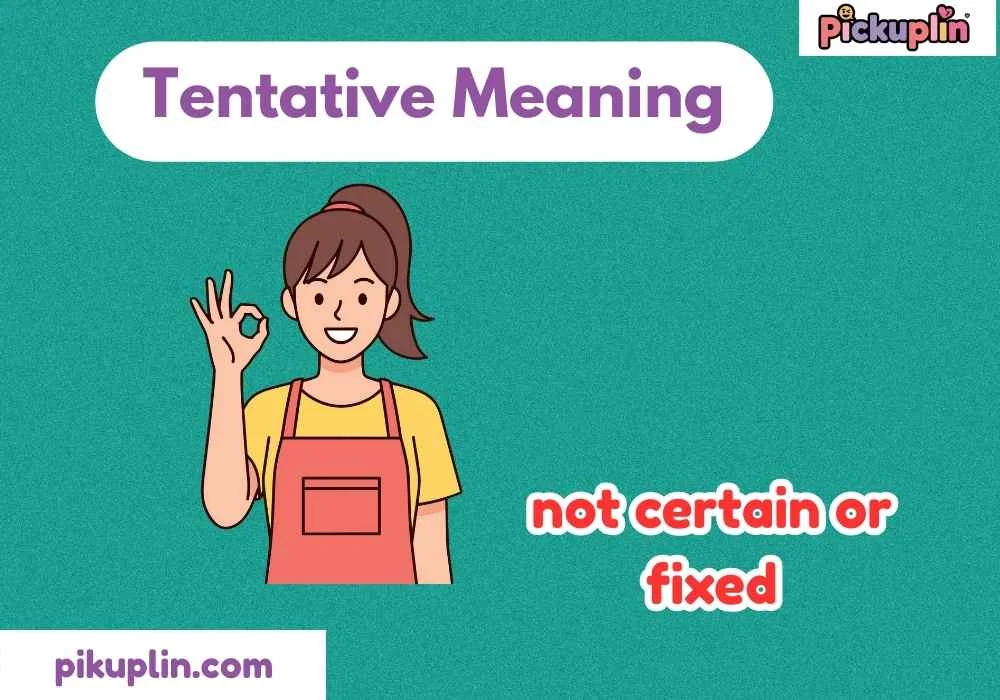
The word tentative is an adjective that describes something that is not certain or fixed. It often refers to actions, plans, or statements that are provisional, cautious, or hesitant.
- Example 1: The meeting time is tentative and may change.
- Example 2: She gave a tentative smile when meeting her new teacher.
In simple words, if something is tentative, it’s subject to change or made carefully with hesitation.
📜 Origin of the Word “Tentative”
The term tentative comes from the Latin word tentare, meaning “to try or attempt”. Over centuries, it evolved into English as a word used to describe uncertain or experimental actions.
💡 Fun fact: The Latin root tentare is also related to words like attempt and intention, showing its connection to trying or testing something.
🔑 Different Meanings of Tentative
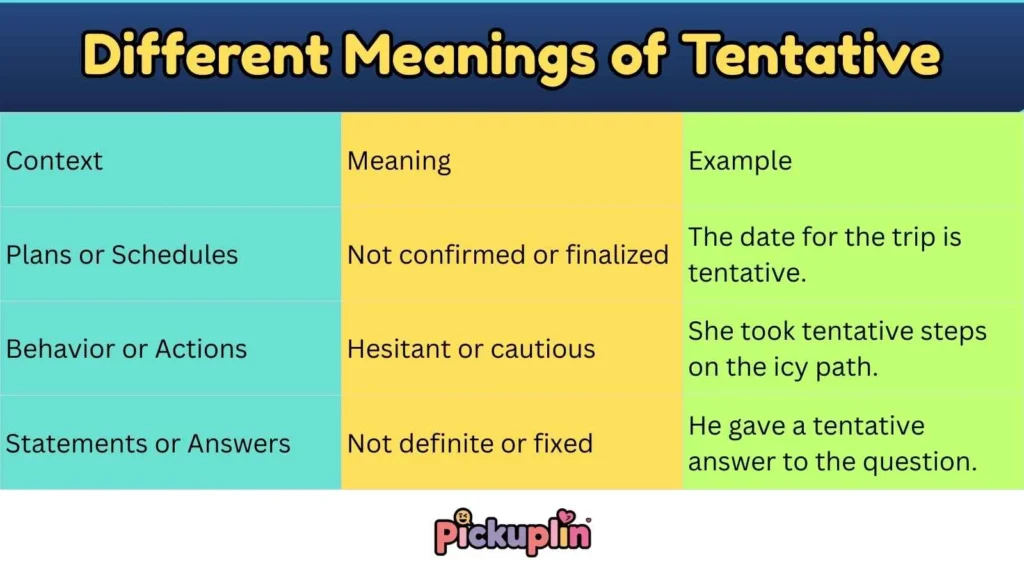
“Tentative” can be used in several contexts. Here’s a quick breakdown:
| Context | Meaning | Example |
|---|---|---|
| Plans or Schedules | Not confirmed or finalized | The date for the trip is tentative. |
| Behavior or Actions | Hesitant or cautious | She took tentative steps on the icy path. |
| Statements or Answers | Not definite or fixed | He gave a tentative answer to the question. |
🧠 Tentative in Everyday Conversations
Using “tentative” correctly can make you sound more precise and professional. Here’s how it often appears:
- Work: “We have a tentative plan for the project launch.”
- School: “The exam schedule is tentative.”
- Social: “Our tentative meeting time is 5 PM.”
🌟 Synonyms for Tentative
Want to expand your vocabulary? Here are some synonyms you can use instead of tentative:
- Provisional ✅
- Hesitant ✅
- Experimental ✅
- Uncertain ✅
- Conditional ✅
❌ Common Misconceptions About Tentative
Many people misuse “tentative” to simply mean slow or weak, but that’s not correct. The word always implies uncertainty or caution, not weakness.
📝 Tentative vs Similar Words
It’s important to distinguish tentative from similar words:
| Word | Difference | Example |
|---|---|---|
| Provisional | Similar, but more formal; often used in official documents | The provisional schedule will be updated next week. |
| Hesitant | Focuses on caution in action rather than plan | He was hesitant to speak in public. |
| Uncertain | Broader term; can describe any unknown situation | We are uncertain about the weather tomorrow. |
📊 How Tentative is Used in Writing
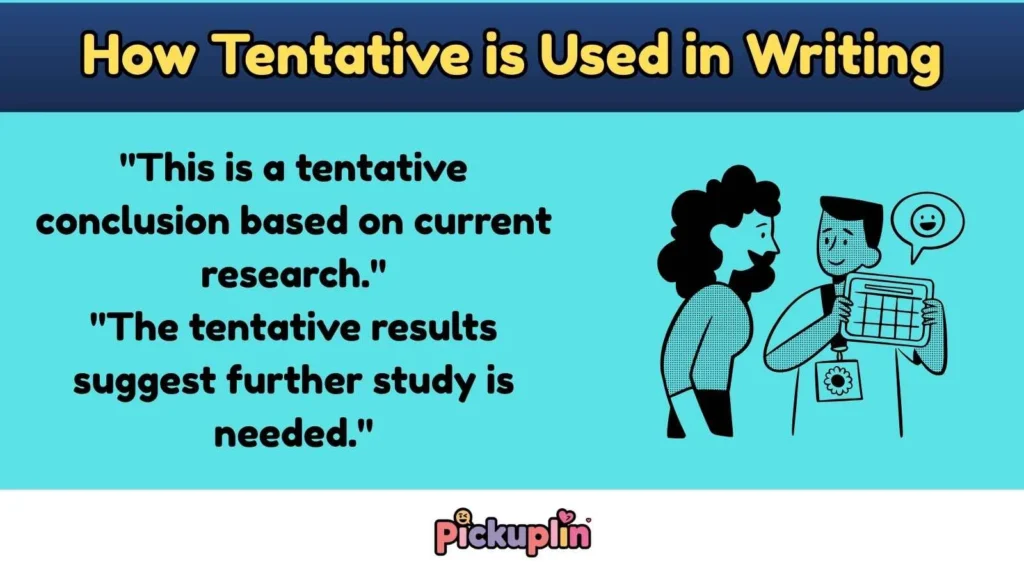
In writing, “tentative” is often used to soften statements or indicate flexibility:
- “This is a tentative conclusion based on current research.”
- “The tentative results suggest further study is needed.”
Using it this way can make your writing appear careful, thoughtful, and professional.
💬 Examples in Sentences
Here are 10 practical examples of “tentative” in everyday English:
- We have a tentative plan to visit Paris next summer.
- Her handshake was tentative but polite.
- The tentative schedule will be shared tomorrow.
- He made a tentative attempt to fix the issue.
- Our tentative agreement is subject to approval.
- She gave a tentative nod, unsure of the answer.
- The tentative budget may change after the review.
- His tentative steps showed his nervousness.
- They set a tentative date for the wedding.
- The tentative hypothesis needs more data to be confirmed.
🧩 Tentative in Business & Academic Contexts
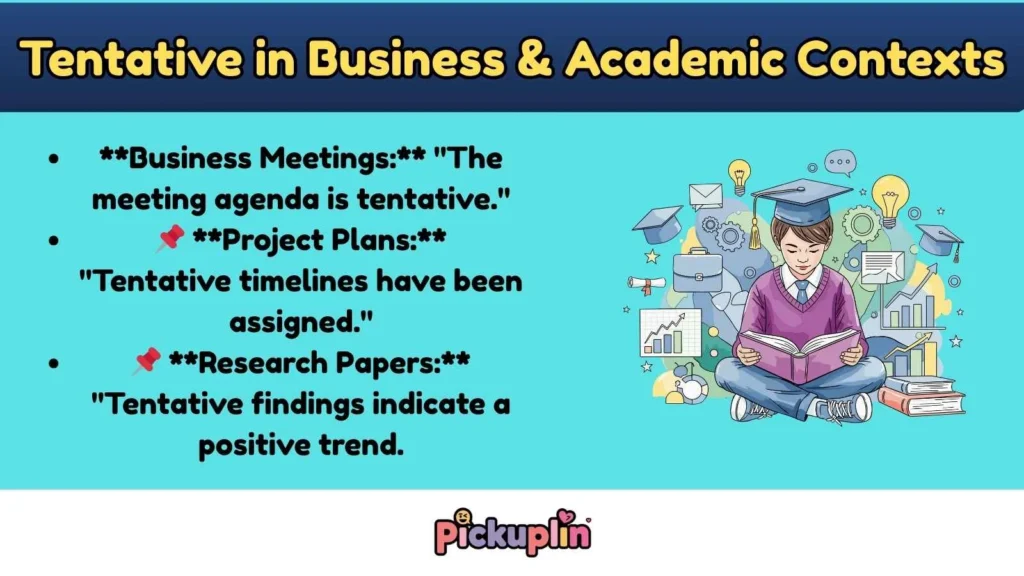
In professional environments, “tentative” is commonly used:
- 📌 **Business Meetings:** “The meeting agenda is tentative.”
- 📌 **Project Plans:** “Tentative timelines have been assigned.”
- 📌 **Research Papers:** “Tentative findings indicate a positive trend.”
This usage shows professionalism while acknowledging uncertainty.
🌐 Related Phrases with Tentative
Some common phrases include:
- Tentative agreement – a preliminary deal
- Tentative date/time – a not-yet-confirmed schedule
- Tentative steps – cautious actions
- Tentative plan – a flexible plan that might change
💡 Tips to Remember Tentative
- Think of it as **“not fully decided yet”**.
- Often signals **politeness or caution** in communication.
- Works well in both **formal and informal** contexts.
- Use with words like **plan, schedule, agreement, conclusion**.
📚 Fun Facts About Tentative
- The word is over **500 years old** in English usage.
- It shares roots with **“attempt”**, emphasizing experimentation.
- Widely used in science, law, and everyday conversation for **uncertainty**.
❓ FAQs
1. What is the tentative meaning in simple words?
Tentative means something is not fixed or certain. It’s a plan, decision, or action made with caution.
2. Can tentative be used for people?
Yes! It describes a person who is hesitant or cautious, like “She gave a tentative smile.”
3. Is tentative formal or informal?
It’s versatile. It works in formal writing, business communication, and everyday conversation.
4. What is the opposite of tentative?
The opposite can be definite, certain, or confident, depending on context.
5. How do you use tentative in a sentence?
Example: “We have a tentative plan to launch the product next week.”
Conclusion
The word tentative is a small but powerful part of English that helps convey uncertainty, caution, and flexibility. 🌟
Whether you’re making plans, writing professionally, or describing behavior, using tentative correctly can make your communication clear, polite, and confident.
Start using it in your daily conversations and writing to sound more precise and professional. Remember, tentative is about trying, experimenting, and staying flexible.

I’m the voice behind Pikuplin, where I simplify meanings, slang, and everyday expressions in a way that actually makes sense. I love breaking down words and phrases so readers can understand not just the definition, but the real meaning behind them. Every piece I write is based on clarity, curiosity, and real human understanding.