Solemn meaning goes far beyond a simple dictionary definition. It carries emotion, seriousness, depth, and respect.
When something is described as solemn, it often marks a moment that deserves silence, attention, or reflection. 🕯️
In everyday life, we hear this word during important ceremonies, emotional events, or serious conversations.
But what does it truly mean? And how do you use it correctly without sounding awkward or forced?
What Is the Solemn Meaning? 📘
The word solemn describes something that is serious, formal, deeply meaningful, or emotionally heavy. It often relates to moments that require respect and seriousness.
When someone says, “It was a solemn occasion,” they usually mean the atmosphere was calm, respectful, and emotionally significant.
In simple words:
- Solemn = serious and respectful
- Solemn = not playful or casual
- Solemn = emotionally meaningful
It can describe:
- A person’s expression
- A promise or oath
- An event or ceremony
- A tone of voice
Origin of the Word Solemn 🕰️
The origin of the word solemn adds depth to its meaning.
It comes from the Latin word “solemnis”, which meant:
- Formal
- Customary
- Religious or ceremonial
Over time, the word moved into Old French and then into English, keeping its association with important rituals and serious moments.
The historical roots of solemn show why the word still feels heavy and respectful today.
Solemn Meaning in Simple Language 🧠
If you had to explain solemn meaning to a child or a beginner, you could say:
Solemn means something is very serious and deserves respect.
There is usually:
- No joking 😐
- No loud behavior
- A calm and quiet mood
Think of moments where people naturally lower their voices and act carefully. That’s solemn.
When Do We Use the Word Solemn? ⏳
The word solemn is not used for daily casual situations. It fits specific contexts where seriousness matters.
Common Situations Where “Solemn” Is Used
- Funerals and memorial services ⚰️
- National ceremonies 🇺🇳
- Serious promises or vows 🤝
- Courtrooms and legal settings ⚖️
- Emotional announcements
Using “solemn” in the wrong place can sound unnatural. For example, a birthday party is rarely solemn 🎉.
Solemn Meaning in Daily Conversations 💬
Even though it sounds formal, solemn is still used in everyday speech—especially when emotions are involved.
Examples:
- “He gave me a solemn look before speaking.”
- “She made a solemn promise to never lie again.”
- “The room fell silent in a solemn moment.”
Here, the word adds emotional weight and seriousness.
Solemn vs Similar Words 🔍
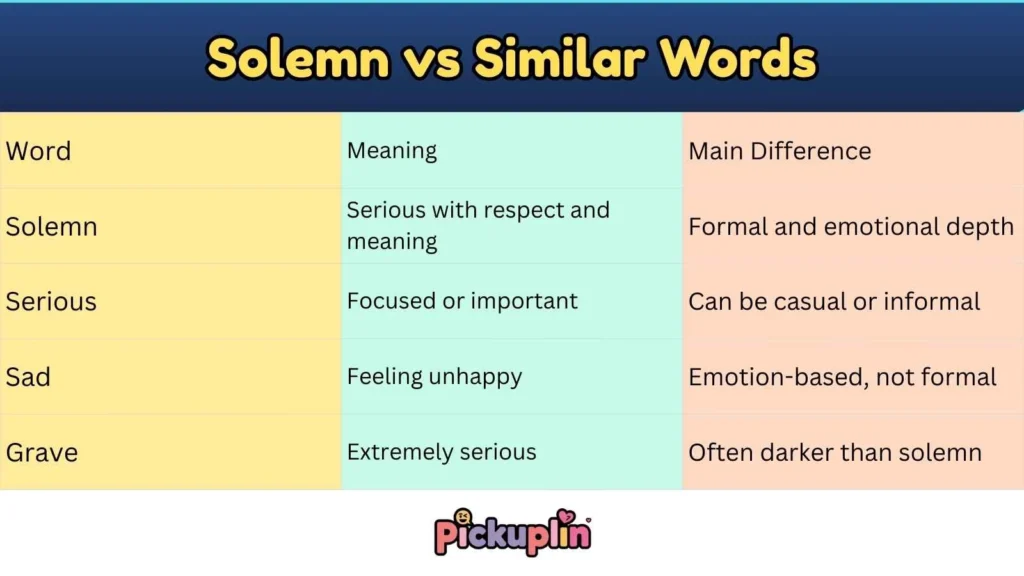
Many people confuse solemn with words like serious or sad. While related, they are not the same.
| Word | Meaning | Main Difference |
|---|---|---|
| Solemn | Serious with respect and meaning | Formal and emotional depth |
| Serious | Focused or important | Can be casual or informal |
| Sad | Feeling unhappy | Emotion-based, not formal |
| Grave | Extremely serious | Often darker than solemn |
Solemn often combines seriousness with respect and formality.
Solemn Meaning in Emotions and Expressions 😔
A solemn expression usually shows:
- Calm seriousness
- Emotional control
- Respect for the moment
It does not always mean sadness. Sometimes it reflects honor, duty, or responsibility.
A solemn face often speaks louder than words.
Solemn Oath and Solemn Promise 🤞
One of the strongest uses of the word appears in phrases like:
- Solemn oath
- Solemn promise
These phrases suggest a commitment that should never be broken.
For example:
“I make a solemn promise to protect the truth.”
This sounds much stronger than a simple promise.
Solemn Meaning in Ceremonies 🎓

Ceremonies are often described as solemn because they follow formal rules and emotional significance.
Examples include:
- Graduation ceremonies
- Military events
- Memorial days
Silence, slow movements, and respectful behavior define a solemn ceremony.
How to Use Solemn Correctly ✍️
To use solemn naturally:
- Use it for meaningful moments
- Avoid casual settings
- Pair it with emotional or formal nouns
Correct: “It was a solemn occasion.”
Incorrect: “We had a solemn picnic.”
Common Mistakes With Solemn 🚫
Here are mistakes people often make:
- Using it as a synonym for sad only
- Using it in happy or fun moments
- Overusing it in casual writing
Remember, solemn is powerful because it is rare.
Solemn Meaning in Writing & Literature 📖
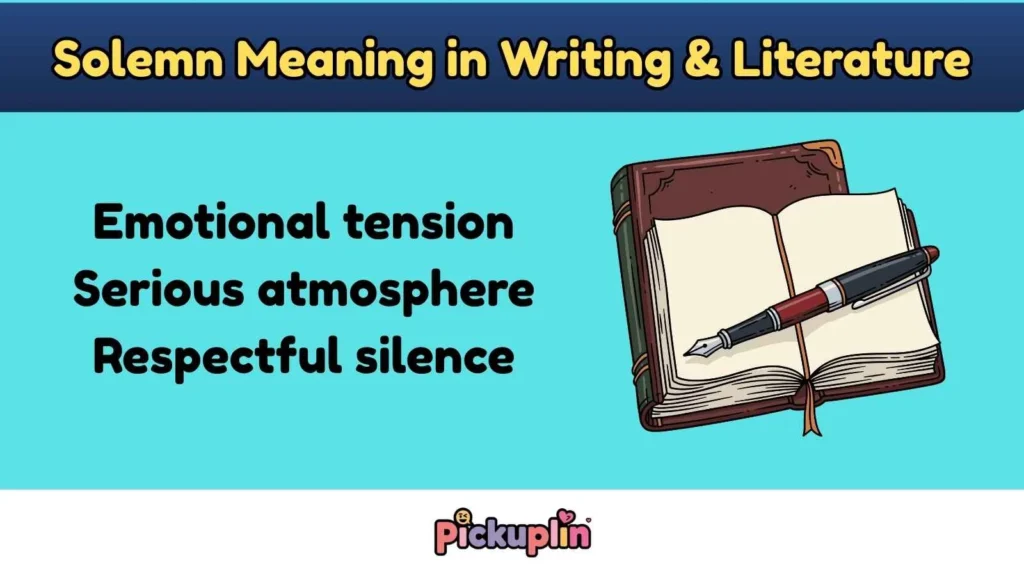
Writers often use the word solemn to set the mood.
It helps create:
- Emotional tension
- Serious atmosphere
- Respectful silence
Even one solemn sentence can change the tone of an entire paragraph.
FAQs
1. Does solemn always mean sad?
No. Solemn means serious and respectful. It can involve sadness, but not always.
2. Can a person be solemn?
Yes. A person can have a solemn personality, tone, or expression.
3. Is solemn a positive or negative word?
It is neutral. The meaning depends on context.
4. Can solemn be used in formal writing?
Absolutely. It fits formal, academic, and professional writing well.
5. What is the closest synonym of solemn?
Words like serious, grave, and dignified are close but not exact.
Final Thoughts:
The solemn meaning reflects seriousness, respect, and emotional depth. It is a word that carries weight and should be used thoughtfully.
Whether describing a moment, a promise, or an expression, solemn adds dignity and meaning when no other word feels strong enough.

I’m the voice behind Pikuplin, where I simplify meanings, slang, and everyday expressions in a way that actually makes sense. I love breaking down words and phrases so readers can understand not just the definition, but the real meaning behind them. Every piece I write is based on clarity, curiosity, and real human understanding.