Ever heard someone shout “skol!” at a party, in a game, or online and wondered, “What does skol mean?” 🤔 You’re not alone.
In this deep-dive guide, we’ll unpack the full meaning of skol, where it comes from, how people use it today, real examples, cultural vibes, and more!
Whether you’re a language lover, curious reader, or just want to stay up-to-date with modern expressions, you’ll enjoy this friendly, expert explanation. 🎉
Right from the start, let’s connect to the real essence: skol is more than a word — it’s a vibe. It’s an expression of celebration, community, and connection across cultures and generations. 🌍
What Is the Meaning of Skol? 🧠
The term skol (pronounced like “skawl”) is an expression many people use to say “cheers!” 🥂 It’s mainly used when people raise glasses during a toast. But don’t be fooled — its meaning runs deeper than just a casual phrase.
Skol means:
- 🍻 Cheers – used when celebrating together
- 🎉 A sign of joy and shared moments
- 🌍 A cultural symbol in parts of Scandinavia
- 🏈 A community chant (e.g. sports teams)
So if you’ve heard someone shout “Skol!,” they’re basically saying, “Here’s to good times!” 🥳
Where Does Skol Come From? 📜
The origin of skol is fascinating. It traces back to the Old Norse word skål, which literally meant “bowl” — the bowl from which people drank together. 🍷
In Old Norse culture (think Vikings and early Scandinavian societies), people gathered around shared bowls during feasts and celebrations. When they clinked cups, they’d say skål, meaning something like “here’s to your health”. Over time, this evolved into today’s expression “skol.”
In modern use, the word traveled through language evolution and cultural exchange. Whether whispered in pubs or shouted in stadiums, it kept the original vibe — fellowship and celebration. 🫂
Pronunciation Guide: How to Say Skol 🎙️
Most people say it like this:
- 👉 Skol — like “skawl”
But pronunciation can vary slightly by region or accent. No matter how you say it, it’s the intention behind the word that matters most! 💬😊
Examples of Skol in Everyday Use 🗣️
Here are some real-world ways skol shows up:
- 🍺 At a party: “Skol, everyone! Let’s celebrate!”
- 🏈 At a game: Fans chanting “Skol!” for unity and energy
- 🌍 International friendships: “Skol!” as a fun toast
- ✨ Social media posts: People captioning pics with “Skol!” to show excitement
These examples show that skol works in formal and casual settings — as long as it’s used with positive vibes! ✨
Skol vs Cheers: What’s the Difference? 🍻
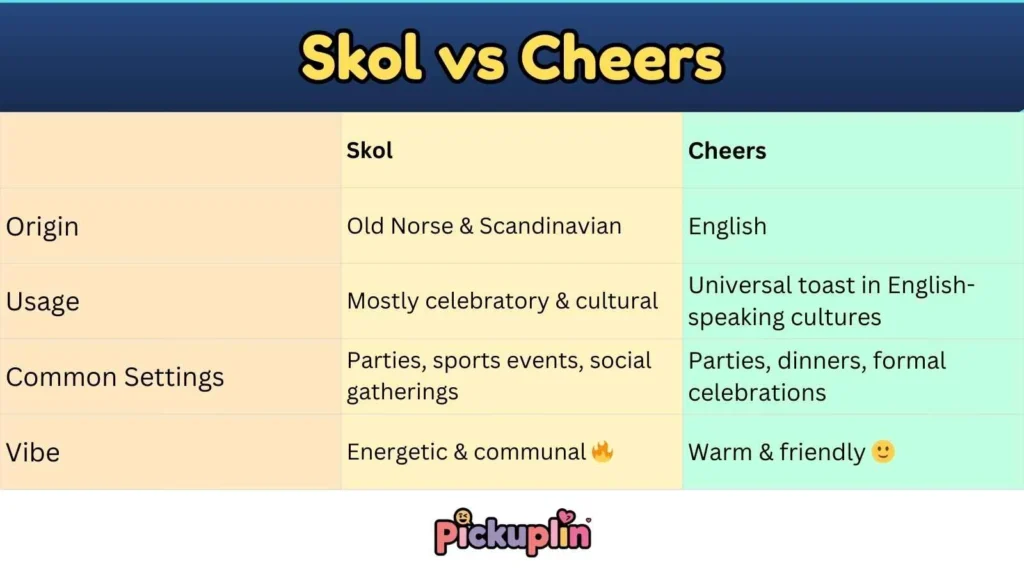
| Skol | Cheers | |
|---|---|---|
| Origin | Old Norse & Scandinavian | English |
| Usage | Mostly celebratory & cultural | Universal toast in English-speaking cultures |
| Common Settings | Parties, sports events, social gatherings | Parties, dinners, formal celebrations |
| Vibe | Energetic & communal 🔥 | Warm & friendly 🙂 |
Although both mean similar things, skol carries a special cultural legacy, especially tied to community and shared experiences. 🧡
Is Skol a Real Word? 🧐
Yes! Skol is absolutely a real word — especially in languages like Swedish, Norwegian, and Danish, where skål is a common expression used during toasts. In English-speaking places, people adopted the term as a fun, culturally rich way to say “cheers.” 🥰
It’s also used more broadly in modern culture, like in sports cheers or online slang. That makes it both historic and trendy! 🌟
Skol in Sports Culture 🏟️
If you follow sports, you’ll notice skol popping up in stadiums, chants, and fan culture. Some fan groups use it as a rallying cry — a short, powerful way to express unity and support for their team. 🙌
Whether fans are cheering during a big play or lifting their voices together at halftime, shouting “Skol!” becomes a shared moment of pride and excitement. 🏆
Fun Facts About Skol 🎈
- 🍻 It started from the word for a drinking bowl in Old Norse.
- 🌐 Today it’s used all around the world, not just in Scandinavia.
- 📣 Fans have turned it into an iconic chant at many sporting events.
- 🎉 It shows up in songs, social media captions, party toasts, and more!
Isn’t it cool how a simple word can carry centuries of culture and meaning? 😄
How to Use Skol Correctly in Conversation 🗨️
Using skol right is all about context. Here’s how to do it like a pro:
- 🍷 At celebrations: “Skol! To our success!”
- 🎉 With friends: “Skol, friends! Let’s make tonight awesome!”
- 🏆 In cheer chants: “Skol! Skol! Skol!”
- 📸 On social media: “Skol to good vibes only!”
Key tip: Always say it with a genuine smile 😊 — that’s the real spirit of skol!
Skol in Different Languages 🌎
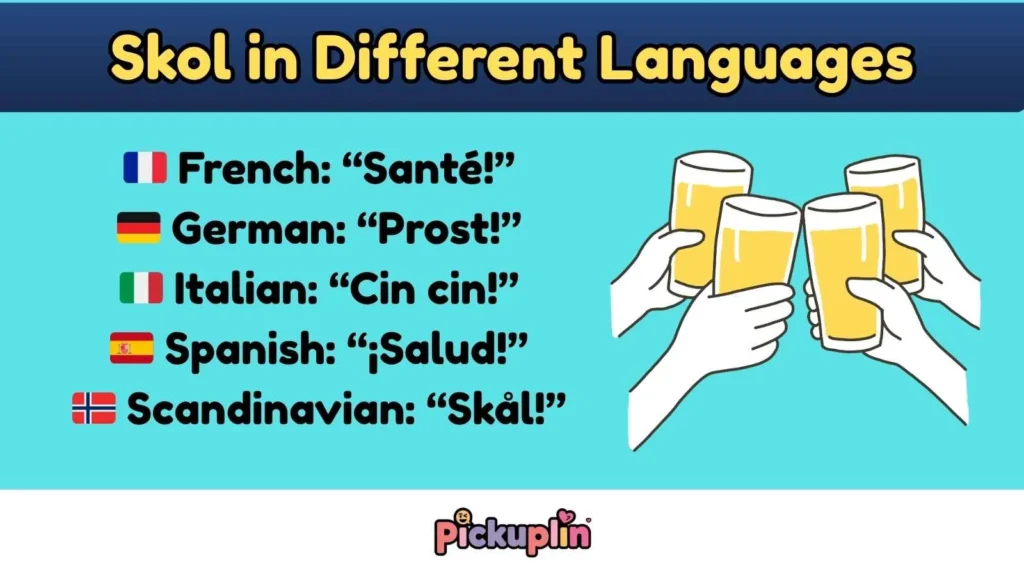
In Scandinavian languages like Swedish and Norwegian, the word is written as skål and pronounced similarly to “skol.” It’s used exactly like “cheers” in English-speaking cultures. 🥂
Different cultures have their own versions of toast words:
- 🇫🇷 French: “Santé!”
- 🇩🇪 German: “Prost!”
- 🇮🇹 Italian: “Cin cin!”
- 🇪🇸 Spanish: “¡Salud!”
- 🇳🇴 Scandinavian: “Skål!” (Skol)
Each of these expressions reflects the joy of shared moments and the human desire to celebrate together. 🎊
Is Skol Slang? 🤷♂️
Yes and no. In its originating languages, skål is standard toast language — not slang. But in English or online use, skol often functions as slang or informal language. Think of it as a borrowed term that became cool and trendy! 😎
People use it casually in chats, messages, and voices to bring a sense of fun and celebration to everyday language. 📱
Examples in Real Conversations 💬
- Friend Group: “Skol! To surviving finals week!” 🎓
- Sports Fans: “Skol Vikings!” 🏈
- Party: “Skol to new friendships!” 🥳
- Online: Comment under a happy photo: “Skol to good vibes!” 📸
These examples show how versatile and fun the word can be! 🎉
Common Questions About Skol 🤔
Is skol just for drinking? 🍹
No! While it’s often used in drinking toasts, it’s also a symbol of celebration, unity, and positive emotions. You can use it anytime you want to express joy or community. 🎈
Can I use skol in a text message? 📱
Absolutely! People use it in group chats, captions, and even memes. It’s a fun way to express shared excitement online. 😄
Is skol appropriate in formal settings? 🧑💼
In formal toasts, other words (like “cheers” or “to your health”) are more common. But in informal celebrations, parties, and friendly events, skol works great! 🥂
Why Skol Feels Special ❤️
Words carry emotion. Some words are flat. But skol feels alive because it brings people together. It creates a moment where everyone pauses, smiles, and connects. 🔗 That’s the magic of shared language — especially one rooted in tradition and celebration.
“Words like ‘skol’ remind us that language is more than communication — it’s connection.” — Language Enthusiast 💬
Skol in Pop Culture 🎥
Pay attention in movies, shows, and video games. You might hear characters use skol as a toast or rallying shout. Its presence in pop culture reflects how the word traveled from ancient traditions to modern entertainment. 🎮🍿
Summary: What You Need to Remember 🧾
- Skol means “cheers” or “here’s to good times.” 🥂
- It comes from the Old Norse word skål. 📜
- Used in celebrations, sports, and social gatherings. 🎉
- It’s both historical and modern! 📅
- Works in texts, conversations, and cheers. 📱🗣️
FAQs
1. What does skol mean?
It’s a celebratory expression meaning “cheers,” used to toast good times and shared moments. 🍻
2. Where did skol originate?
From the Old Norse word skål, used in ancient Scandinavian cultures for toasts and gatherings. 🌍
3. Is skol slang?
In English use, yes — it’s informal and fun. In Scandinavian languages, it’s standard for toasts. 🗨️
4. Can I use skol anywhere?
Mostly in casual or celebratory settings. For formal events, other toast words might be better. 🎩
5. How do you pronounce skol?
Like “skawl.” Simple and fun! 🎤
🎯 Conclusion
The word skol has traveled through time — from ancient bowls in Viking halls to modern stadium chants and social posts. 😊
At its heart, it’s about celebration, unity, and joy. Whether you shout it with friends or use it online, you’re tapping into a long tradition of expressing good vibes and connection. 🌟
Next time you’re raising a glass, sharing a laugh, or cheering on your team, remember the rich meaning behind skol — and let the good times flow! 🍻

I’m the voice behind Pikuplin, where I simplify meanings, slang, and everyday expressions in a way that actually makes sense. I love breaking down words and phrases so readers can understand not just the definition, but the real meaning behind them. Every piece I write is based on clarity, curiosity, and real human understanding.