Sanctimonious meaning is one of those language topics that instantly sparks curiosity. You may have heard someone say, “Don’t be so sanctimonious,” in a debate, movie, or online discussion — but what does it actually mean? 🤔
In simple terms, sanctimonious describes a person who acts morally superior to others — often in a way that feels fake, exaggerated, or performative. It’s not just about being good. It’s about showing off goodness in a way that annoys people.
This complete expert guide breaks down the word in a clear, friendly, and practical way. You’ll learn definitions, origin, tone, examples, comparisons, and smart usage tips — all in plain English.
Sanctimonious Meaning in Simple Words 🧠
The sanctimonious meaning is: pretending to be morally better or more righteous than others, especially in a way that seems insincere.
Plain definition:
A sanctimonious person behaves as if they are morally superior — but often comes across as fake or self-righteous.
It’s important to note something: being truly kind or ethical is positive. Being sanctimonious is negative because it suggests showiness and hypocrisy.
Quick Understanding Snapshot ⚡
- Tone: Negative
- Used for: Behavior, speech, attitude
- Implies: Moral show-off behavior
- Common context: Arguments, criticism, social commentary
Pronunciation and Word Form 🔊
Knowing the sanctimonious meaning is helpful — but saying it correctly builds confidence too.
Pronunciation: sank-tuh-MOH-nee-us
| Form | Word |
|---|---|
| Adjective | Sanctimonious |
| Noun | Sanctimony |
| Adverb | Sanctimoniously |
Example: He spoke sanctimoniously about rules he never followed himself.
Origin and History of the Word 📜
Understanding word origin often makes meaning stick better. The sanctimonious meaning comes from older religious language.
- Root word: Sanctimony
- Latin root: sanctus = holy
- Original idea: Sacred or holy behavior
Over time, the word shifted in tone. Instead of describing true holiness, it began to describe fake holiness or exaggerated moral display. Language evolves — and this is a great example. 📚
When Is Someone Called Sanctimonious? 🎭
Someone is described as sanctimonious when they:
- Constantly lecture others about morality
- Show off their “goodness” publicly
- Judge others harshly
- Act pure but behave differently in private
- Use moral talk to feel superior
It’s not about being right. It’s about the attitude behind the behavior.
Example situation:
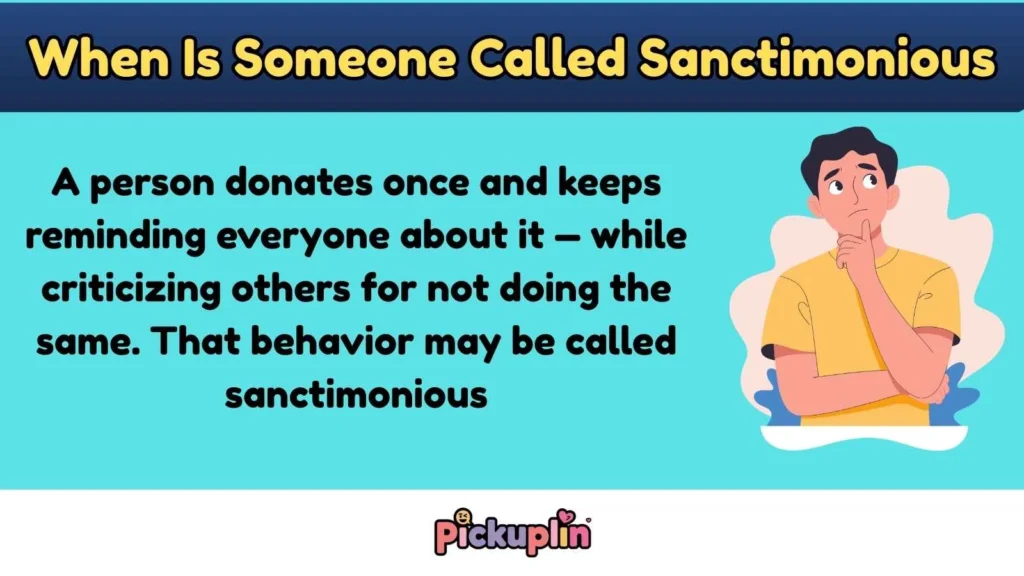
A person donates once and keeps reminding everyone about it — while criticizing others for not doing the same. That behavior may be called sanctimonious. 💬
Sanctimonious Meaning vs Similar Words ⚖️
Many words overlap with the sanctimonious meaning, but each has a slightly different shade.
| Word | Meaning | Difference |
|---|---|---|
| Self-righteous | Believes they are morally correct | May be sincere |
| Holier-than-thou | Acts morally superior | Informal phrase |
| Pretentious | Tries to impress | Not always moral-based |
| Hypocritical | Says one thing, does another | Action conflict focused |
| Sanctimonious | Displays fake moral superiority | Focuses on moral performance |
Real-Life Sentence Examples 📝
Examples help lock in the sanctimonious meaning. Here are practical, everyday uses:
- His sanctimonious tone made the discussion uncomfortable.
- She sounded sanctimonious when talking about simple habits.
- The speech felt more sanctimonious than helpful.
- He gave a sanctimonious lecture about honesty.
- The comment section turned sanctimonious very quickly.
Formal vs Casual Use 🎯
Formal: The article adopted a sanctimonious moral stance.
Casual: Stop being so sanctimonious about it.
Positive vs Negative Moral Behavior 🌗
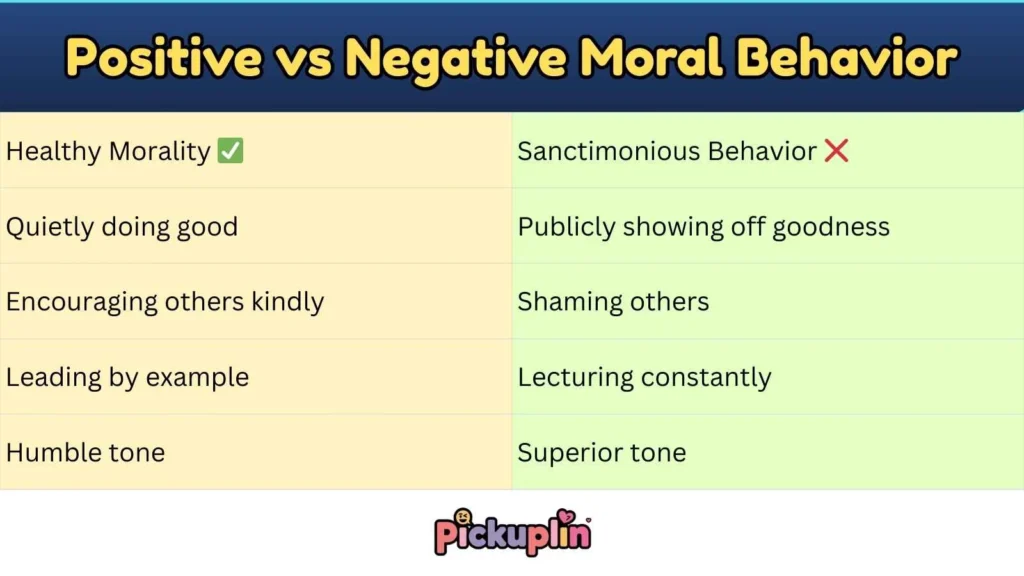
Let’s clarify something important. Moral behavior itself is good. The sanctimonious meaning applies when moral behavior becomes performative or judgmental.
| Healthy Morality ✅ | Sanctimonious Behavior ❌ |
|---|---|
| Quietly doing good | Publicly showing off goodness |
| Encouraging others kindly | Shaming others |
| Leading by example | Lecturing constantly |
| Humble tone | Superior tone |
Psychology Behind Sanctimonious Behavior 🧩
Language experts often observe that sanctimonious behavior connects to social image. People sometimes want recognition more than impact.
Common drivers include:
- Desire for praise
- Need for social approval
- Identity signaling
- Group status building
- Fear of criticism
This doesn’t always mean bad intent — but the delivery creates the negative impression.
How to Avoid Sounding Sanctimonious 🎤
Understanding the sanctimonious meaning also helps you avoid being perceived that way.
- Share experiences, not lectures
- Use “I” instead of “you should”
- Stay humble in tone
- Acknowledge your own flaws
- Offer help, not judgment
Example shift:
Instead of: “People like you never care.”
Say: “What helped me was trying this approach.”
Common Contexts Where the Word Appears 📰
You will often see the sanctimonious meaning used in:
- Political commentary
- Opinion pieces
- Social media debates
- Movie dialogue
- Book reviews
- Cultural criticism
It frequently appears when someone criticizes tone, not just message.
Mini Dialogue Examples 🎬
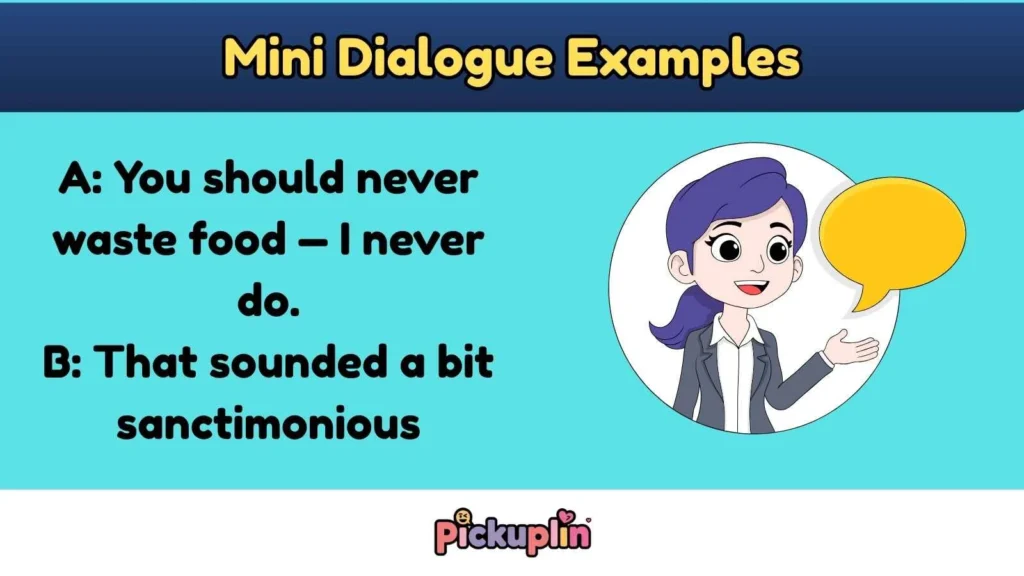
Example 1:
A: You should never waste food — I never do.
B: That sounded a bit sanctimonious.
Example 2:
The reviewer’s sanctimonious style distracted from the real message.
Related Vocabulary You Should Know 📚
- Sanctity – holiness
- Virtue signaling – showing values publicly for approval
- Moralizing – giving moral lectures
- Righteousness – moral correctness
- Pious – devout or religious
Featured Snippet Style Definition 📌
Sanctimonious meaning: describing a person who pretends to be morally superior to others in a way that appears fake, exaggerated, or self-righteous.
FAQs
Is sanctimonious always an insult?
Yes, it is usually negative. It criticizes tone and attitude rather than moral belief itself.
Can a good person sound sanctimonious?
Yes. Even honest advice can sound sanctimonious if delivered with superiority or judgment.
Is sanctimonious related to religion?
The word has religious roots, but modern usage applies to any moral superiority behavior.
What is the difference between sanctimonious and hypocritical?
Sanctimonious focuses on moral showiness. Hypocritical focuses on acting opposite to what you claim.
Is sanctimonious formal or informal?
It is considered a formal descriptive word but appears in everyday speech too.
Conclusion:
The sanctimonious meaning goes beyond simple morality. It describes behavior that feels morally superior, performative, and insincere.
Understanding this word helps you read tone more accurately, communicate more wisely, and avoid sounding judgmental yourself.
Language is powerful. Tone matters as much as truth. When you combine honesty with humility, your message becomes stronger and more respected. 🌟

I’m the voice behind Pikuplin, where I simplify meanings, slang, and everyday expressions in a way that actually makes sense. I love breaking down words and phrases so readers can understand not just the definition, but the real meaning behind them. Every piece I write is based on clarity, curiosity, and real human understanding.