
Rescind meaning is a term that often appears in legal documents, official notices, contracts, and even everyday conversations—but many people still find it confusing. 🤔 Does it mean cancel? Reverse? Take back? Or something deeper?
In this in-depth guide, you’ll learn exactly what “rescind” means, how it’s used in law and daily life, where it originated, and how to apply it correctly with confidence.
What Does Rescind Mean? 🧠
The word rescind means to officially cancel, revoke, or take back a decision, law, contract, or agreement as if it never existed.
When something is rescinded, it is not just stopped—it is voided retroactively. That means the action is undone from the beginning.
To rescind is to pull something back with authority and intention.
Unlike pausing or suspending an action, rescinding removes its legal or practical effect entirely.
Simple Definition
Rescind = to cancel something formally and completely.
Rescind Meaning in Everyday Language 💬
In everyday use, rescind often appears in formal situations, such as:
- Job offers
- School admissions
- Company policies
- Government decisions
Example:
The company rescinded the job offer after discovering false information.
Here, rescind means the offer was taken back officially, not just delayed.
Origin and History of the Word “Rescind” 📜
Understanding the origin of a word builds trust and depth. ✅
The word rescind comes from the Latin word rescindere, meaning:
- re = back
- scindere = to cut
So, literally, rescind means “to cut back” or “tear away”.
This origin explains why rescind is so powerful—it implies a clean break from a previous decision.
Rescind Meaning in Law ⚖️
In legal contexts, rescind meaning becomes even more precise and important.
To rescind a contract means:
- The contract is canceled
- Both parties return to their original positions
- Any obligations are removed
Legal Example
The court rescinded the contract due to misrepresentation.
This means the agreement is treated as if it never existed.
Rescind vs Cancel: What’s the Difference? 🔍
| Term | Meaning | Formality |
|---|---|---|
| Rescind | Cancel retroactively with authority | Very Formal |
| Cancel | Stop something from continuing | Informal to Formal |
Key difference: Cancel stops future action. Rescind erases past action.
Common Situations Where “Rescind” Is Used 📌
- Employment: Rescinding job offers
- Education: Rescinding admissions
- Government: Rescinding laws or policies
- Business: Rescinding contracts
- Finance: Rescinding transactions
In all cases, rescind implies authority, finality, and formality.
How to Use “Rescind” in a Sentence ✍️
Here are clear, natural examples:
- The university rescinded the scholarship offer.
- The board rescinded its earlier decision.
- The company rescinded the policy after complaints.
- The contract was rescinded due to fraud.
Notice how rescind is often paired with official decisions.
Synonyms of Rescind (With Context) 🔄
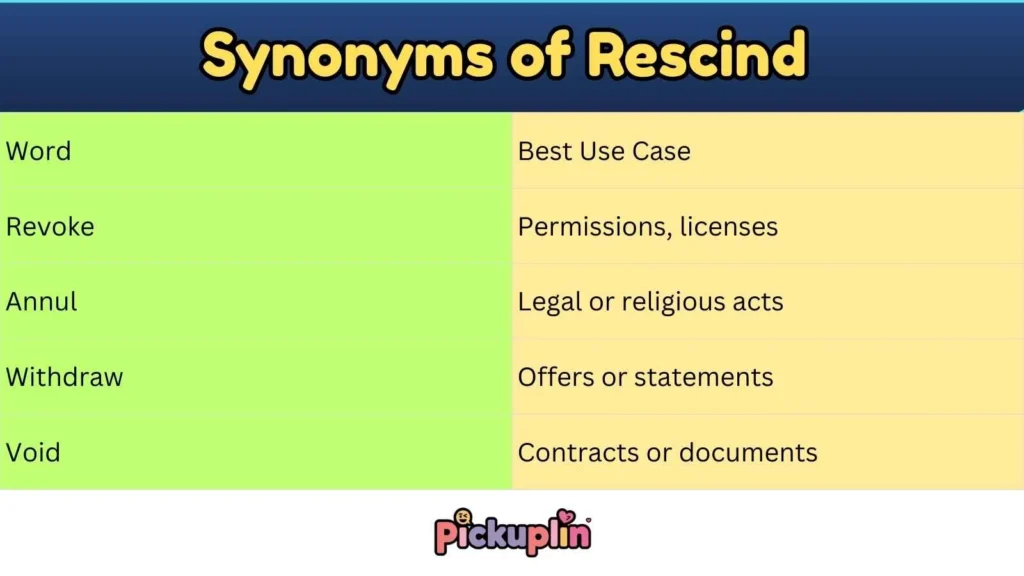
While rescind has close synonyms, each carries a slightly different tone.
| Word | Best Use Case |
|---|---|
| Revoke | Permissions, licenses |
| Annul | Legal or religious acts |
| Withdraw | Offers or statements |
| Void | Contracts or documents |
Rescind is the most formal and authoritative of them all.
Antonyms of Rescind 🚫
- Approve
- Confirm
- Ratify
- Enforce
These words represent moving forward—not backward.
Is “Rescind” Always Negative? 🤔
Not necessarily.
While rescind often follows mistakes or disputes, it can also be:
- A correction
- A protective action
- A responsible decision
For example, rescinding an unfair policy can be a positive step.
Grammar Tips: Rescind vs Rescinded vs Rescission 📚
- Rescind – present tense
- Rescinded – past tense
- Rescission – noun form
Example:
The rescission of the contract was finalized yesterday.
Why “Rescind” Is Common in Formal Writing 🏛️
The word rescind conveys:
- Authority
- Legal clarity
- Professional tone
That’s why it appears in official letters, legal notices, and corporate announcements.
Rescind Meaning in Business and Contracts 💼
In business, rescinding a contract protects parties from:
- Fraud
- Misinformation
- Unfair terms
It ensures fairness and transparency—key trust factors in professional environments.
Common Mistakes When Using “Rescind” ❌
- Using it in casual conversation
- Confusing it with “cancel”
- Applying it without authority
Tip: If the action isn’t formal or official, rescind may not be the right word.
FAQs
What is the exact meaning of rescind?
Rescind means to officially cancel or revoke something as if it never existed.
Is rescind a legal term?
Yes. Rescind is commonly used in legal, business, and governmental contexts.
Can a decision be rescinded?
Yes, especially if made by an authority such as a board, court, or institution.
Is rescind the same as revoke?
They are similar, but rescind often applies to agreements, while revoke applies to permissions.
Final Thoughts:
Understanding the rescind meaning empowers you to read contracts confidently, interpret official announcements correctly, and communicate with precision.
It’s more than just a word—it’s a signal of authority, responsibility, and finality.
When used correctly, rescind adds clarity and professionalism to your language.

I’m the voice behind Pikuplin, where I simplify meanings, slang, and everyday expressions in a way that actually makes sense. I love breaking down words and phrases so readers can understand not just the definition, but the real meaning behind them. Every piece I write is based on clarity, curiosity, and real human understanding.