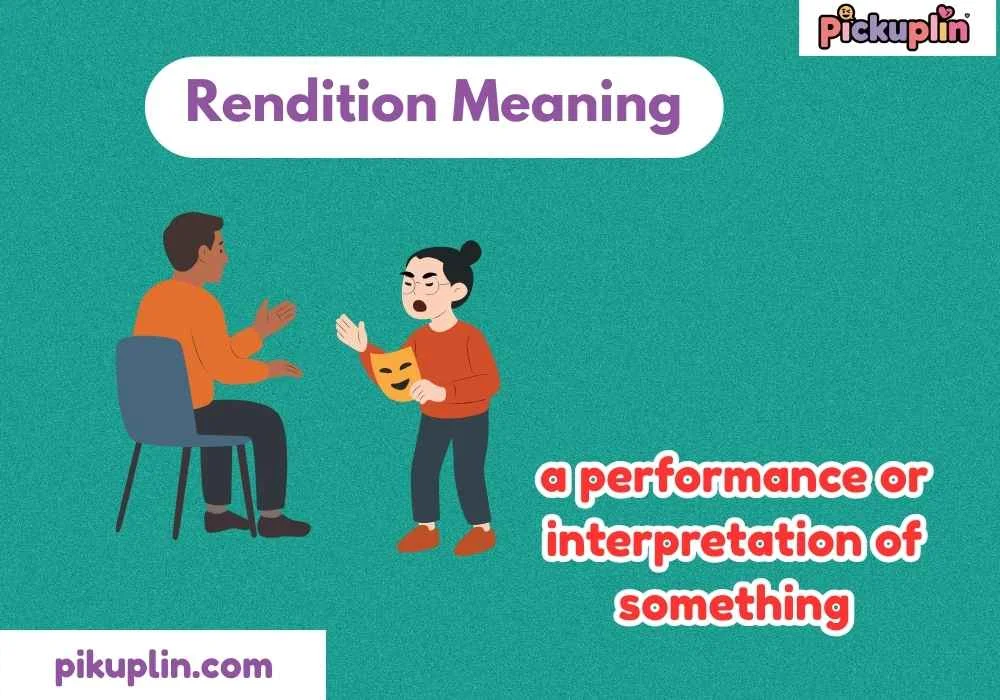
Rendition meaning is a term that appears in everyday language, legal discussions, music, art, and even international affairs.
Yet, many people find it confusing because its meaning subtly changes depending on the context. If you have ever wondered what “rendition” truly means and how to use it correctly, you’re in the right place 😊.
In this in-depth guide, we’ll break down the rendition meaning in plain English, explore its origins, examine real-life examples, and explain how it’s used across different fields. By the end, you’ll feel confident using this word naturally and accurately.
What Is the Meaning of Rendition? 🤔
At its core, the rendition meaning refers to the act of performing, presenting, or delivering something. This “something” can be a song, a speech, a translation, a visual artwork, or even a person in a legal sense.
In simple terms:
Rendition means how something is given, performed, or represented.
The word focuses not just on what is delivered, but how it is delivered.
Origin and History of the Word Rendition 🕰️
Understanding the origin helps clarify the rendition meaning.
The word “rendition” comes from the Latin word reddere, which means “to give back” or “to deliver.” Over time, it moved through Old French into English, where it took on broader meanings.
- Latin: reddere (to give back)
- Old French: rendre (to return or deliver)
- Modern English: rendition (a performance or presentation)
This historical evolution explains why rendition often implies interpretation rather than simple repetition.
Rendition Meaning in Simple Words 🧠
Let’s simplify it further.
Rendition means:
- A way something is performed
- A way something is presented
- A way something is translated or interpreted
For example:
“Her rendition of the song was emotional and powerful.”
Here, rendition refers to her unique performance of the song.
Different Contexts of Rendition Meaning 🌍
The rendition meaning changes slightly depending on the field. Let’s explore the most common contexts.
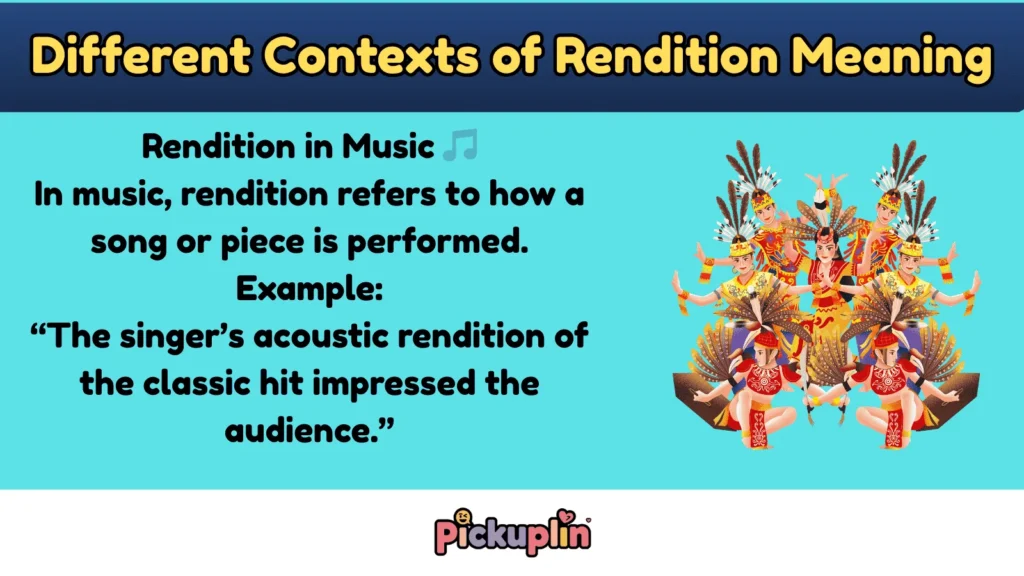
1. Rendition in Music 🎵
In music, rendition refers to how a song or piece is performed.
Example:
“The singer’s acoustic rendition of the classic hit impressed the audience.”
Here, rendition highlights the style, emotion, and interpretation of the song.
2. Rendition in Art and Design 🎨
In visual arts, a rendition is a visual representation of an idea, building, or concept.
Example:
“The architect shared a digital rendition of the new building.”
This means a visual depiction rather than the final product.
3. Rendition in Language and Translation 🌐
In translation, the rendition meaning refers to how accurately and naturally a text is translated.
Example:
“The English rendition of the poem captured its emotional depth.”
A good rendition focuses on meaning, not just word-for-word translation.
4. Rendition in Law and Politics ⚖️
In legal terms, rendition means the act of handing over a person, especially between countries.
Example:
“The suspect was subject to international rendition.”
This usage is formal and carries serious legal implications.
Rendition vs Similar Words ⚖️
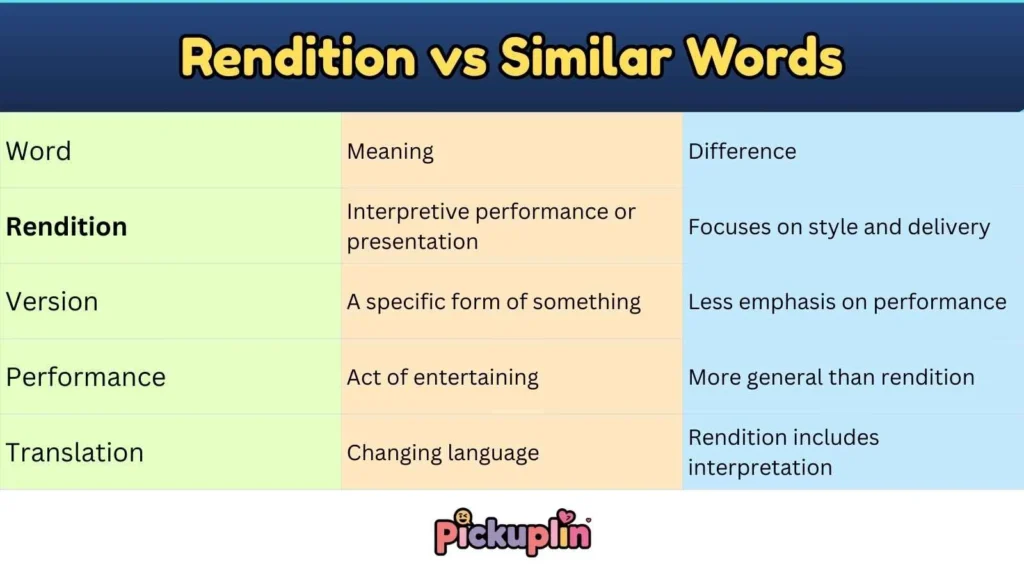
Many people confuse rendition with similar terms. Let’s clear that up.
| Word | Meaning | Difference |
|---|---|---|
| Rendition | Interpretive performance or presentation | Focuses on style and delivery |
| Version | A specific form of something | Less emphasis on performance |
| Performance | Act of entertaining | More general than rendition |
| Translation | Changing language | Rendition includes interpretation |
Why Rendition Meaning Matters in Communication 💬
Understanding the rendition meaning helps you communicate more precisely.
It allows you to:
- Describe performances accurately
- Critique art and music professionally
- Explain translations clearly
- Understand legal discussions
Words matter, and rendition adds depth and nuance to your language.
Real-Life Examples of Rendition 🧩
Here are some everyday examples:
- Music: “His jazz rendition of the song felt fresh.”
- Art: “The artist’s rendition of the city was stunning.”
- Language: “This rendition of the text is clearer.”
- Law: “The case involved cross-border rendition.”
Each example shows how flexible the word is.
How to Use Rendition in a Sentence ✍️
Using the word correctly boosts your writing quality.
Tips:
- Use it when interpretation matters
- Avoid it for purely factual repetition
- Pair it with descriptive adjectives
Example:
“Her emotional rendition of the poem moved everyone.”
Common Mistakes When Using Rendition ❌
Let’s avoid common errors.
- ❌ Using rendition when “copy” is better
- ❌ Using it without context
- ❌ Confusing it with “edition”
Pro tip: If style or interpretation is involved, rendition is usually correct.
Rendition Meaning in Modern Usage 📱
Today, rendition is widely used in:
- Music reviews
- Design presentations
- Legal reporting
- Creative writing
Its versatility makes it a powerful word in modern English.
FAQs
1. What is the simplest definition of rendition?
The simplest rendition meaning is the way something is performed or presented.
2. Is rendition only used in music?
No. Rendition is used in music, art, language, law, and design.
3. Can rendition mean translation?
Yes. A rendition can be an interpreted translation, focusing on meaning.
4. Is rendition a formal word?
It can be both formal and informal, depending on context.
5. How is rendition different from version?
Rendition emphasizes style and interpretation, while version does not.
Final Thoughts:
The rendition meaning goes far beyond a simple definition. It captures the essence of how something is delivered, interpreted, or expressed.
Whether you’re discussing music, art, language, or law, understanding this word helps you communicate with clarity and confidence.
When you use “rendition” correctly, your language becomes richer, more precise, and more professional.

I’m the voice behind Pikuplin, where I simplify meanings, slang, and everyday expressions in a way that actually makes sense. I love breaking down words and phrases so readers can understand not just the definition, but the real meaning behind them. Every piece I write is based on clarity, curiosity, and real human understanding.