Quirky meaning is one of those language topics that feels instantly familiar — yet slightly hard to define with precision. You’ve probably heard someone say, “She’s quirky,” or “That’s a quirky idea.” It usually sounds positive, sometimes playful, and occasionally a little odd. But what does it truly mean? 🤔
In everyday conversation, quirky describes something that is unusual in a charming, interesting, or unexpected way. It suggests individuality, personality, and harmless difference — not weirdness in a negative sense. Still, context matters a lot. Tone, setting, and culture can shift the meaning.
This complete guide explains the quirky meaning in depth — with origin, psychology, tone differences, examples, comparison tables, and real-world usage. By the end, you’ll know exactly how and when to use it with confidence. 🚀
What Does Quirky Mean? 📘
The word quirky is an adjective. It describes a person, object, behavior, or idea that is unusual in a distinctive and often appealing way.
Simple definition:
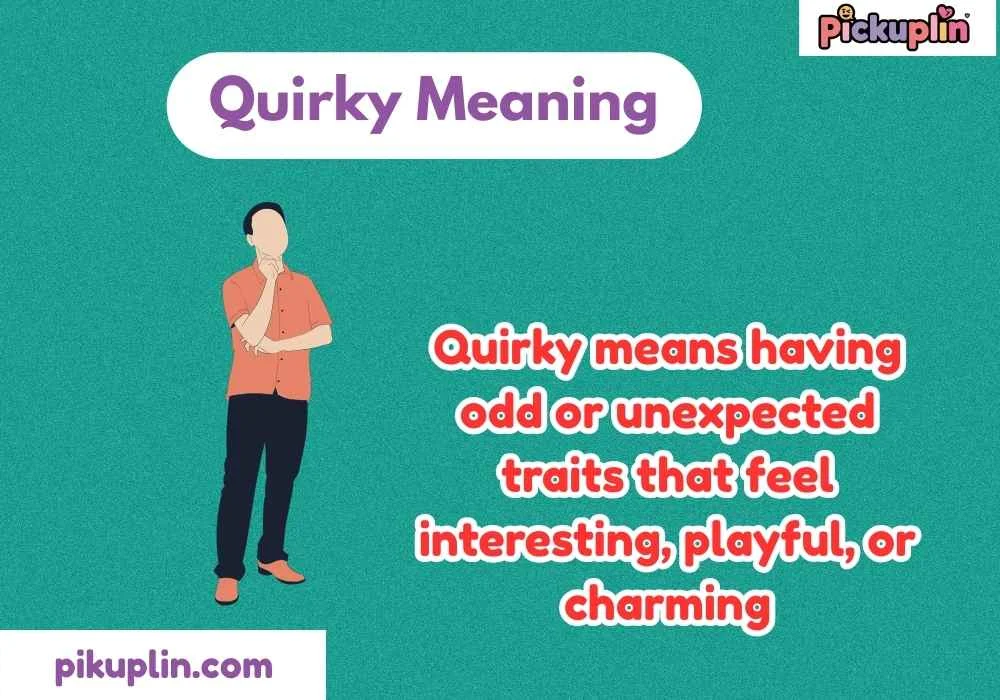
Quirky means having odd or unexpected traits that feel interesting, playful, or charming.
It often suggests originality rather than strangeness. When used positively, it highlights personality and uniqueness. When used carelessly, it can imply oddness without social awareness — but that is less common today.
Quick Snapshot Definition ⚡
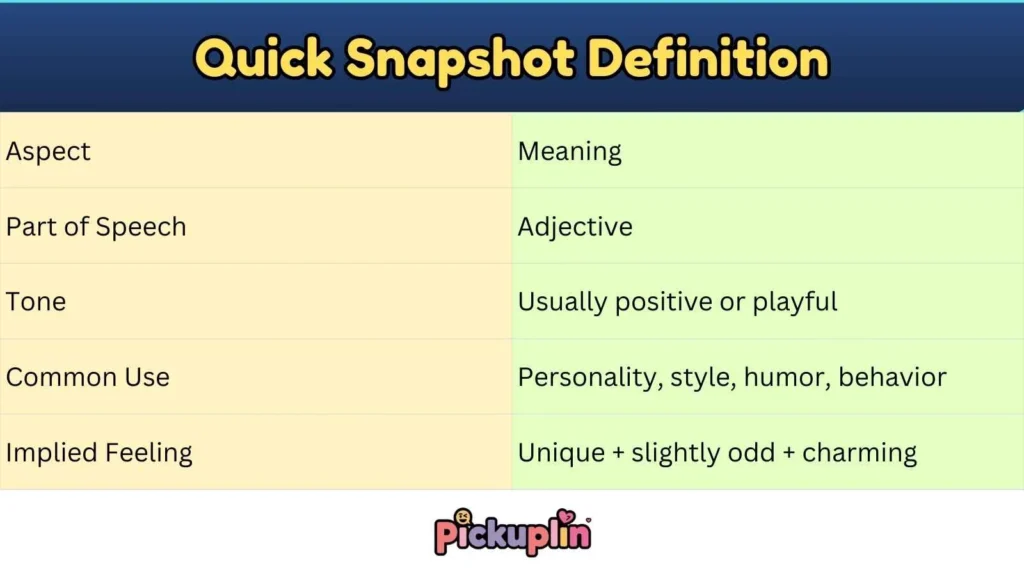
| Aspect | Meaning |
|---|---|
| Part of Speech | Adjective |
| Tone | Usually positive or playful |
| Common Use | Personality, style, humor, behavior |
| Implied Feeling | Unique + slightly odd + charming |
Origin of the Word Quirky 🕰️
Understanding quirky meaning becomes easier when you look at its linguistic roots. The base word “quirk” appeared centuries ago and originally meant a sudden twist, curve, or unexpected turn.
Over time, the idea of a “twist” moved from physical shape to personality traits. A quirk became a small, unusual habit or behavior. Then quirky developed as the descriptive form.
- Original sense → a twist or curve
- Later sense → a behavioral oddity
- Modern sense → charmingly unusual personality
This evolution explains why quirky often feels playful instead of negative. 🎯
Quirky Meaning in Personality 👤
When describing people, quirky usually highlights individuality. It suggests that someone behaves differently — but in a way others find interesting or endearing.
Examples of a quirky personality:
- Wearing colorful mismatched socks daily 🧦
- Collecting unusual objects
- Using creative phrases in normal talk
- Having unexpected hobbies
- Making playful jokes at random moments 😄
Notice something important: these are not harmful traits. They are harmless deviations from the norm. That’s why quirky often feels positive.
Quirky vs Weird vs Eccentric 🔍
Many readers confuse quirky with similar words. However, each carries a slightly different emotional weight.
| Word | Feeling | Typical Tone |
|---|---|---|
| Quirky | Unusual + charming | Positive 😊 |
| Weird | Strange + unexpected | Neutral or negative 😐 |
| Eccentric | Very unconventional | Neutral or respectful 🎩 |
| Odd | Different from normal | Context-dependent |
Key insight: Quirky usually suggests likable difference. Weird may suggest discomfort. Eccentric suggests strong individuality, often associated with artists or inventors.
When Quirky Is a Compliment 💬
In modern usage, calling someone quirky is often a soft compliment. It signals originality and personality. Many people proudly accept the label.
It works as praise when:
- The behavior is harmless
- The tone is warm
- The context is social or creative
- The speaker shows appreciation
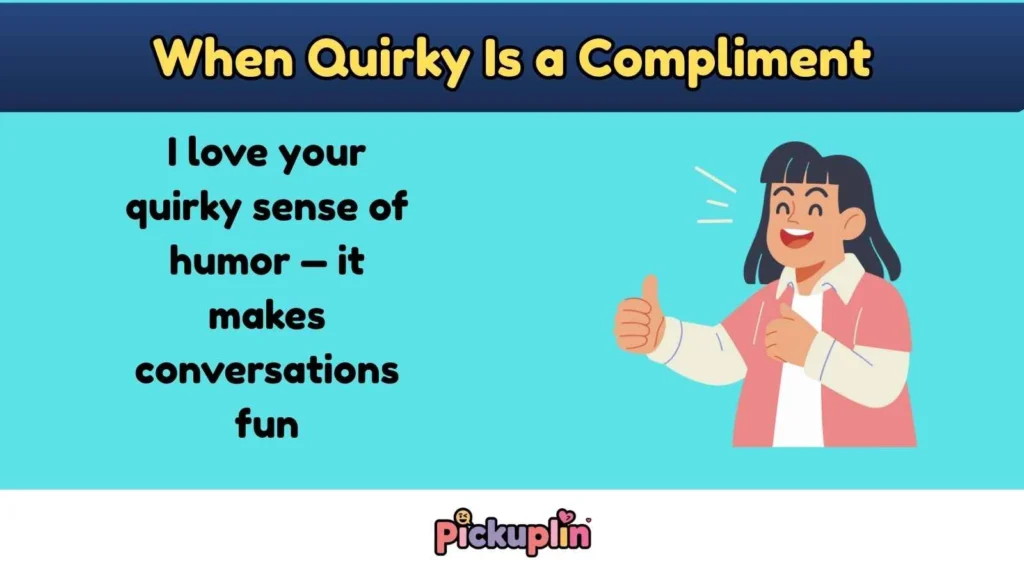
“I love your quirky sense of humor — it makes conversations fun.”
That sentence clearly shows positive intent. 🌟
When Quirky Can Sound Negative ⚠️
Although mostly positive, quirky meaning can shift if tone changes. It may feel dismissive if used sarcastically or in professional criticism.
It may sound negative when:
- Used with a mocking tone
- Applied to serious situations
- Used to avoid direct criticism
- Paired with eye-rolling or sarcasm
Example: “His methods are… quirky.”
That pause changes the meaning. Context matters. 🎭
Examples of Quirky in Sentences 📝
Examples help lock in quirky meaning faster than definitions alone. Here are practical sentence uses:
- She has a quirky style that stands out in every room. 🎨
- The movie is full of quirky characters.
- His quirky habits make him memorable.
- That café has a quirky interior design.
- Her quirky jokes keep everyone laughing. 😂
Notice how each example links difference with charm.
Quirky in Creative Writing ✍️
Writers often use quirky to quickly signal character personality. It creates instant mental imagery.
Quirky character traits may include:
- Unexpected routines
- Unique clothing choices
- Playful speech patterns
- Strange but lovable habits
Because of this, quirky characters are common in comedy, indie films, and light fiction. They feel human and memorable. 🎬
Quirky in Design, Fashion, and Branding 🎯
Beyond personality, quirky meaning appears in visual and brand language too. It suggests originality and playful uniqueness.
Common uses:
- Quirky logo design
- Quirky packaging
- Quirky fashion accessories 👓
- Quirky home décor
Brands use quirky elements to feel approachable and distinctive instead of corporate and stiff.
Psychology Behind Quirky Behavior 🧠
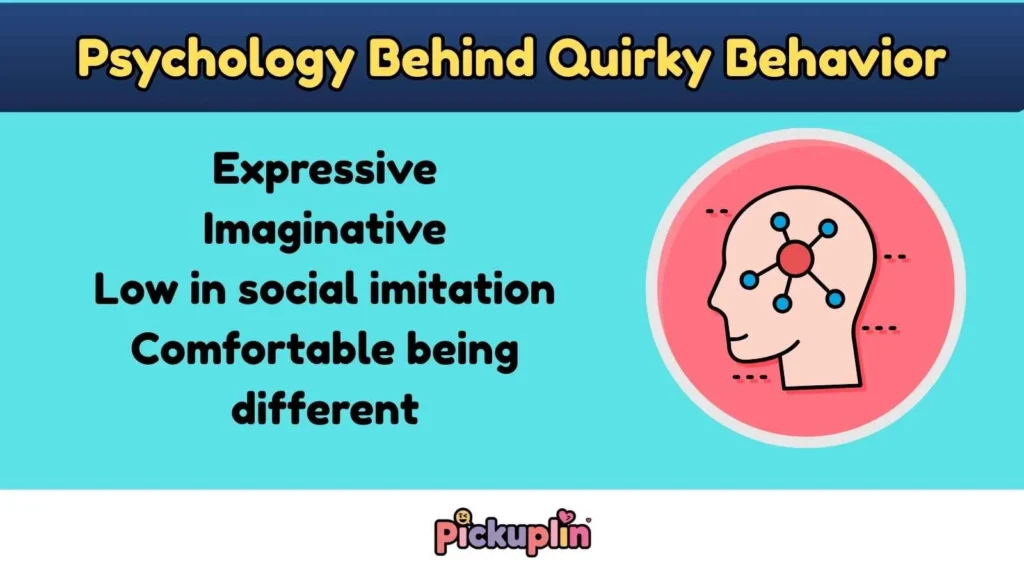
From a behavioral viewpoint, quirky traits often come from creative thinking and comfort with individuality. People described as quirky are usually:
- Expressive
- Imaginative
- Low in social imitation
- Comfortable being different
Importantly, quirky does not imply instability or dysfunction. It suggests personality variation within healthy limits.
Common Traits People Call Quirky ⭐
| Trait | Why It Feels Quirky |
|---|---|
| Talking to plants 🌱 | Playful behavior |
| Inventing words | Creative expression |
| Colorful notebooks | Visual uniqueness |
| Unusual collections | Specific interests |
| Random fun facts | Unexpected knowledge |
How to Use Quirky Correctly ✅
To use the word correctly, follow these expert tips:
- Use it for harmless differences
- Avoid using it for serious flaws
- Match your tone to your intent
- Use it in social or creative context
- Pair it with positive descriptors
Good: quirky and creative
Risky: quirky and unreliable
Popular Synonyms for Quirky 📚
- Offbeat
- Unconventional
- Playful
- Whimsical
- Idiosyncratic
- Unusual
Each synonym overlaps — but none exactly replaces quirky meaning. That’s why the word stays popular.
Featured Snippet Style Definition 📌
Quirky meaning: describing a person or thing that has unusual, distinctive traits that feel charming, playful, or interesting rather than strange or negative.
Practical Usage Scenarios 🌍
- Social introductions
- Character descriptions
- Creative reviews
- Brand storytelling
- Casual compliments
FAQs
Is quirky always positive?
Most of the time, yes. It usually suggests charming uniqueness. Tone can change the effect.
Can objects be described as quirky?
Yes. Designs, places, ideas, and styles can all be called quirky if they feel playfully unusual.
Is quirky the same as weird?
No. Weird may feel uncomfortable. Quirky usually feels likable and light.
Is quirky professional language?
It fits creative and informal settings best. Use carefully in formal reports.
Can quirky describe humor?
Absolutely. Quirky humor means unexpected, playful jokes and observations. 😄
Conclusion:
The quirky meaning centers on charming uniqueness. It highlights harmless difference, creative personality, and playful originality.
Whether used for people, design, humor, or storytelling, it adds warmth and character to description.
Understanding tone and context helps you use the word with precision and confidence. When used thoughtfully, quirky becomes a powerful compliment — not just a label.

I’m the voice behind Pikuplin, where I simplify meanings, slang, and everyday expressions in a way that actually makes sense. I love breaking down words and phrases so readers can understand not just the definition, but the real meaning behind them. Every piece I write is based on clarity, curiosity, and real human understanding.