Polyglot meaning goes far beyond simply “knowing many languages.” It represents curiosity, cultural openness, and the ability to connect deeply with people across the world 🌎. In today’s globalized digital age, the word polyglot has gained massive attention — especially among learners, travelers, creators, and professionals.
But what does being a polyglot really mean? Is it about fluency? Accent? Perfection? Or something more human and practical?
This guide answers all of that — clearly, simply, and expertly. By the end, you’ll understand the true polyglot meaning, how it differs from similar terms, real-life examples, myths, benefits, and whether you can become one too 😊.
What Is the Meaning of Polyglot? 🤔
The word polyglot refers to a person who can speak, understand, or use multiple languages. The number isn’t fixed, but typically it means knowing three or more languages at a functional level.
Polyglot meaning (simple definition):
A polyglot is someone who can communicate in several languages with practical understanding.
Importantly, being a polyglot does not require native-level fluency in every language. Many polyglots operate at different proficiency levels — and that’s completely valid.
Key idea: Communication matters more than perfection ✔️
Origin and Etymology of the Word Polyglot 📜
Understanding the origin helps clarify the polyglot meaning.
The word comes from Greek:
- Poly = many
- Glotta / Glossa = tongue or language
Later, it passed through Latin (polyglottus) and French before entering English.
Originally, the term was often used for:
- Scholars who studied many languages
- Religious translators
- Ancient texts written in multiple languages
Today, the meaning has evolved to include everyday speakers, learners, and global citizens 🌐.
Polyglot vs Multilingual vs Bilingual 🔍
Many people confuse these terms, so let’s break them down clearly.
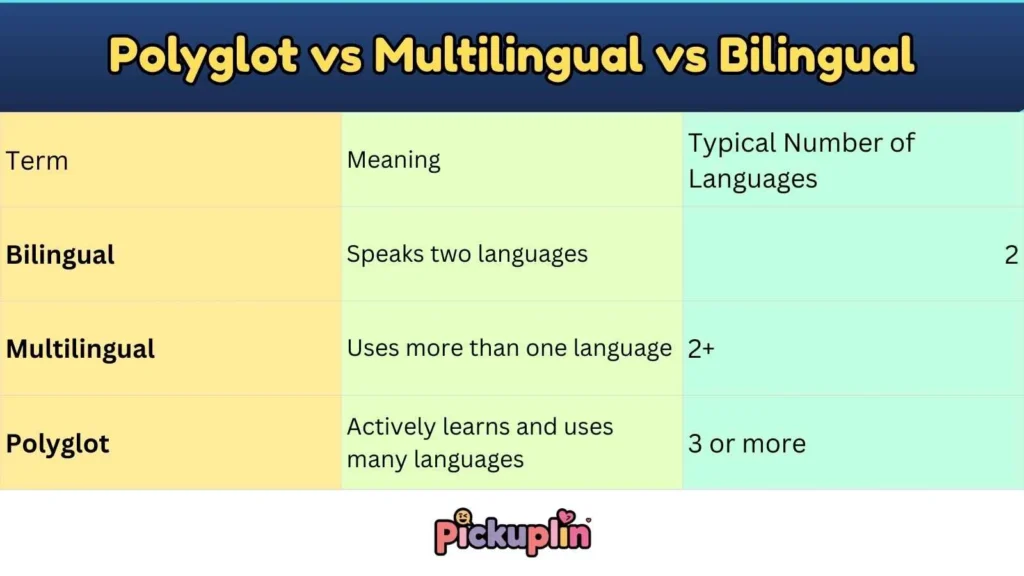
| Term | Meaning | Typical Number of Languages |
|---|---|---|
| Bilingual | Speaks two languages | 2 |
| Multilingual | Uses more than one language | 2+ |
| Polyglot | Actively learns and uses many languages | 3 or more |
Important distinction: A multilingual person may know several languages due to environment. A polyglot is often intentional, curious, and passionate about language learning ❤️.
How Many Languages Does a Polyglot Speak? 🔢
There is no official rule, but common understanding suggests:
- 3–4 languages → Beginner polyglot
- 5–7 languages → Advanced polyglot
- 8+ languages → Hyperpolyglot 🚀
However, numbers alone don’t define the polyglot meaning. Proficiency, consistency, and communication ability matter more.
Someone who speaks four languages comfortably is more of a polyglot than someone who memorized ten but can’t communicate.
What Does Being a Polyglot Really Mean? 🧠
At its core, the polyglot meaning includes:
- Language adaptability
- Cultural empathy
- Curiosity about people
- Lifelong learning mindset
Polyglots don’t chase perfection. They chase connection 🤝.
They often:
- Mix languages naturally
- Learn through conversation
- Accept mistakes as progress
Real-Life Examples of Polyglots 🌟
Here are practical examples to clarify the polyglot meaning:
- A traveler who speaks English, Spanish, French, and Arabic
- A content creator learning languages to connect globally
- A professional using multiple languages for work
- A student passionate about linguistics
Polyglots are not limited to academics. They exist everywhere — online, offline, and across cultures.
Common Myths About Polyglots ❌
Let’s break some myths that confuse people.
Myth 1: Polyglots Speak Perfectly
False. Most polyglots speak with accents and make mistakes — and that’s okay.
Myth 2: You Need Talent
False. Language learning is a skill, not magic 🧩.
Myth 3: Polyglots Memorize Everything
False. They forget — just like everyone else. They simply practice more.
Benefits of Being a Polyglot 💡
The benefits go far beyond language.
- Stronger memory and focus
- Better career opportunities
- Cross-cultural understanding
- Improved problem-solving
- Global confidence
Studies show multilingual individuals often think more flexibly and creatively 🎨.
Is Polyglotism a Skill or Identity? 🪞
For many, the polyglot meaning becomes part of identity.
It’s not about showing off. It’s about:
- Respecting cultures
- Listening deeply
- Learning continuously
Polyglotism blends skill with mindset — making it both practical and personal.
Can Anyone Become a Polyglot? ✅
Yes — absolutely.
You don’t need:
- A “language gene”
- Perfect pronunciation
- Unlimited time
You need:
- Consistency
- Curiosity
- Patience
Even learning one new language puts you on the polyglot path 🛤️.
Polyglot Meaning in Modern Digital Culture 💻
Today, polyglots thrive online.
You’ll see them:
- Creating multilingual content
- Connecting global communities
- Learning through apps and media
Language learning is no longer locked in classrooms — it’s alive everywhere.
FAQs
What is the simplest polyglot meaning?
A polyglot is someone who can communicate in multiple languages.
Is knowing three languages enough?
Yes. Three functional languages often qualify someone as a polyglot.
Do polyglots think differently?
Many develop flexible thinking and cultural awareness.
Is polyglot the same as fluent?
No. Fluency varies by language. Communication matters more.
Can adults become polyglots?
Absolutely. Age is not a barrier 🚫.
Final Thoughts:
The true polyglot meaning isn’t about counting languages — it’s about building bridges between people, cultures, and ideas.
Polyglots are learners for life. They listen more than they speak. They value connection over perfection.
If language excites you even a little, you’re already closer than you think 💬.
Explore more language insights and guides to continue your learning journey. 🌟

I’m the voice behind Pikuplin, where I simplify meanings, slang, and everyday expressions in a way that actually makes sense. I love breaking down words and phrases so readers can understand not just the definition, but the real meaning behind them. Every piece I write is based on clarity, curiosity, and real human understanding.