Para meaning is one of those terms that seems simple at first—but the deeper you go, the more layers you discover. 🤯 From everyday language and slang to academic writing, military terms, psychology, and even online culture, the word para carries multiple meanings depending on context.
If you’ve ever wondered “What does para mean?” or felt confused seeing it used in different situations, you’re not alone. This guide breaks it all down in a clear, friendly, expert way—without jargon, without fluff, and with real-world examples you can actually relate to. ✅
By the end of this article, you’ll understand the para meaning across languages, fields, and modern usage—plus when and how to use it correctly.
What Does Para Mean? (Simple Definition) 🧠
At its core, the para meaning depends heavily on context. The word para can function as:
- A prefix meaning “beside,” “beyond,” or “related to”
- A short form of “paragraph” in writing
- A standalone word in slang or informal speech
- A term used in professional fields like medicine, military, and psychology
So, there isn’t just one definition. Instead, para meaning shifts based on how and where it’s used.
Key idea: Para is a flexible word with multiple meanings tied to context, usage, and field.
Origin and Etymology of Para 📜
To truly understand the para meaning, we need to look at its roots.
The word para comes from the ancient Greek word “παρά (pará)”, which means:
- Beside
- Alongside
- Beyond
- Against
This Greek root made its way into Latin and later into English, where it became a commonly used prefix.
That’s why many English words beginning with para- relate to ideas of closeness, similarity, or deviation.
Para as a Prefix in English 🔤
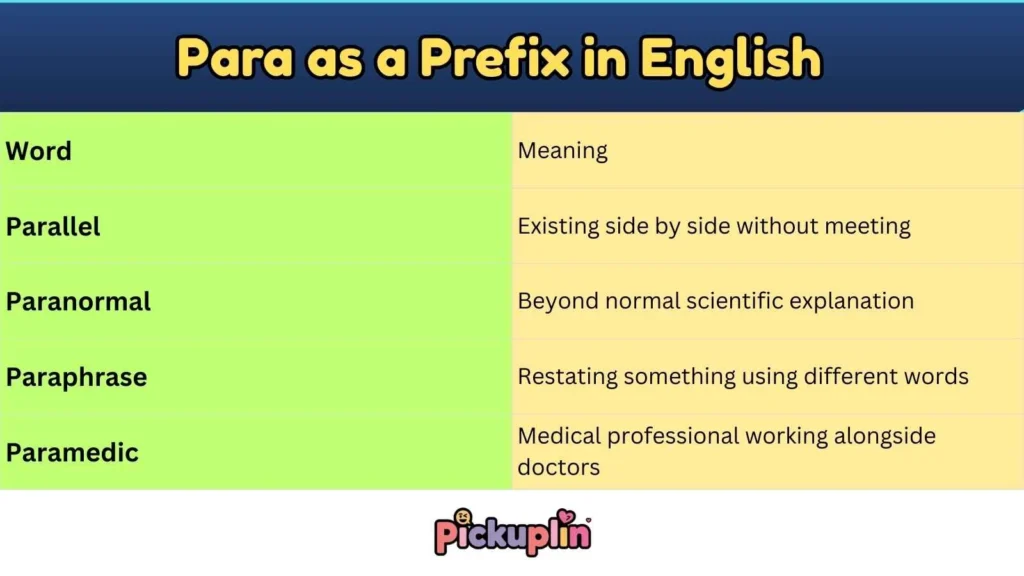
One of the most important uses of para meaning is as a prefix.
Common Words Using Para-
| Word | Meaning |
|---|---|
| Parallel | Existing side by side without meeting |
| Paranormal | Beyond normal scientific explanation |
| Paraphrase | Restating something using different words |
| Paramedic | Medical professional working alongside doctors |
In all these examples, para meaning reflects the idea of being beside, related to, or beyond something else.
Para Meaning in Writing and Education ✍️
In academic and professional writing, para is commonly used as an informal abbreviation.
Para = Paragraph
When editors, teachers, or students say “Check para 3”, they usually mean:
“Check paragraph 3.”
This usage is especially common in:
- Essay editing
- Academic feedback
- Legal documents
- Content writing workflows
Here, the para meaning is practical and efficiency-driven.
Para Meaning in Slang and Informal Speech 💬
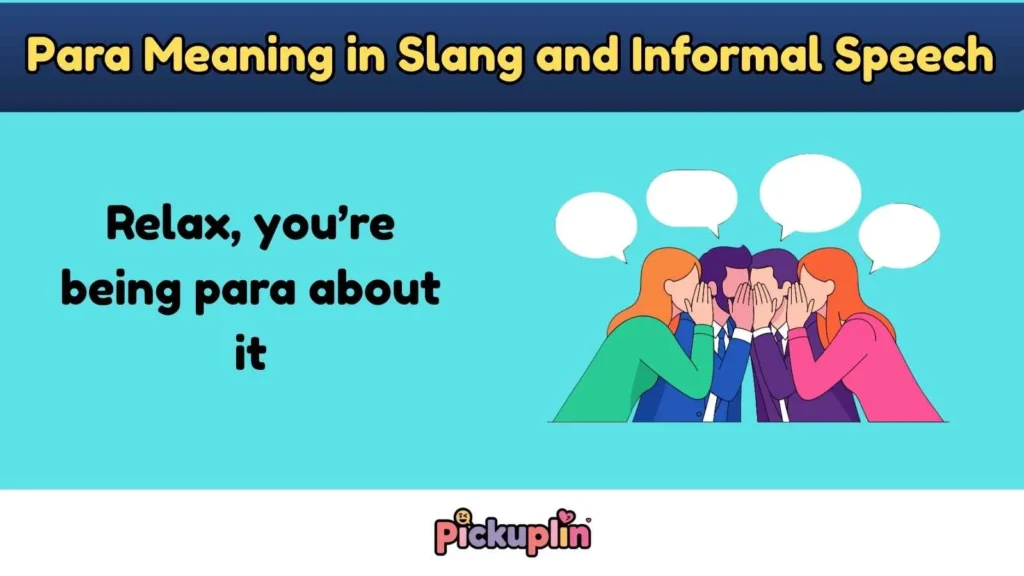
In casual conversations and online chats, para meaning can change again.
In some communities, para is used to describe someone who is:
- Overly dramatic
- unreasonable
- Overreacting
Example:
“Relax, you’re being para about it.”
In this context, para is a shortened form of unreasonable. This usage is informal and should be avoided in professional settings.
Para Meaning in Military and Aviation 🪂
In military terminology, para has a very specific meaning.
Para = Paratrooper
A para refers to a soldier trained to parachute into combat zones.
- British Army Paras
- Airborne units
- Special operations forces
Here, the para meaning is tied to airborne deployment and elite training.
Para Meaning in Medicine and Science 🧬
In medical and scientific contexts, para often appears in technical terms.
Medical Examples
- Paralysis – Loss of muscle function
- Parathyroid – Glands beside the thyroid
- Paraesthesia – Tingling or abnormal sensation
Again, the original Greek sense of “beside” or “abnormal” plays a key role in para meaning here.
Para Meaning in Psychology 🧠
In psychology, para often appears in discussions of perception and mental states.
Words like paranoia and paraphrenia relate to thoughts or beliefs that deviate from typical reasoning.
This reinforces a recurring theme: para meaning often involves something existing outside or alongside the norm.
Para Meaning Across Languages 🌍
The word para exists in many languages, often with different meanings.
| Language | Para Meaning |
|---|---|
| Spanish | For / In order to |
| Portuguese | For / Toward |
| Urdu / Hindi | Informally used for paragraph or slang |
This multilingual usage can sometimes confuse learners, but context always clarifies the para meaning.
Common Confusions About Para ❌
Many people misunderstand para meaning. Let’s clear up a few myths:
- Para is not always slang – It can be formal or technical
- Para doesn’t always mean unreasonable
- Para as a prefix is not a word by itself
Understanding context is everything.
Real-Life Examples of Para Usage ✅
Here are some natural examples showing how para meaning changes:
- Writing: “Your para needs a stronger topic sentence.”
- Slang: “Don’t be para, it’s not that serious.”
- Medical: “The patient experienced paraesthesia.”
- Military: “He trained as a para in the airborne unit.”
Why Understanding Para Meaning Matters 🎯
Misusing para can lead to:
- Miscommunication
- Confusion in academic writing
- Unprofessional tone
Knowing the correct para meaning ensures clarity, credibility, and confidence in communication.
FAQs
Is para a real word?
Yes. Para is both a standalone term and a widely used prefix.
What does para mean in slang?
In slang, para often means unreasonable or overly worried.
Is para formal or informal?
It can be both. Academic and medical uses are formal, while slang usage is informal.
Does para always mean paragraph?
No. That meaning is specific to writing and editing contexts.
Can para have different meanings in different fields?
Absolutely. Context defines the para meaning.
Final Thoughts:
The para meaning is a perfect example of how language evolves across time, cultures, and professions.
Whether you’re writing an essay, chatting with friends, studying medicine, or exploring language, understanding how para works gives you a real communication advantage.
Always pay attention to context—and you’ll never misuse it again. 💡

I’m the voice behind Pikuplin, where I simplify meanings, slang, and everyday expressions in a way that actually makes sense. I love breaking down words and phrases so readers can understand not just the definition, but the real meaning behind them. Every piece I write is based on clarity, curiosity, and real human understanding.