Have you ever seen someone text “ight” and wondered what it actually means? 🤔 Whether in social media chats, texting, or gaming, the term “ight” has become a staple in informal communication.
In this guide, we’ll break down the ight meaning, its origin, usage, examples, and why it’s so popular among different age groups.
By the end of this article, you’ll understand “ight” fully and be able to use it naturally in conversation.
What Does “Ight” Mean? 💬
The word “ight” is a slang term derived from the word “alright.” It is commonly used in casual conversations to indicate agreement, acknowledgment, or approval. It can also convey a sense of “okay” or “fine.”
- Example 1: “I’ll meet you at 7 pm.” – “Ight.” ✅
- Example 2: “Can you finish this today?” – “Ight, I’ll try.” 💪
In essence, ight is the shortened, informal version of alright, used mainly in text messages, online chats, and social media platforms.
Origin of “Ight” 📜
The slang “ight” originated in African American Vernacular English (AAVE) and became widely popular through hip-hop culture and online communities. Over time, it spread to mainstream social media platforms like Twitter, Instagram, and Snapchat. Its brevity makes it ideal for texting, where speed and convenience are essential.
Different Uses of “Ight” 📝
Depending on context, “ight” can convey various emotions and intentions:
| Use | Meaning | Example |
|---|---|---|
| Agreement | Okay, sure | “Ight, let’s do it.” |
| Acknowledgment | Understood, got it | “Ight, I understand.” |
| Approval | Sounds good, fine | “Ight, that works for me.” |
| Casual Sign-Off | Bye, see you | “Ight, catch you later.” |
Examples of “Ight” in Texting 💬
Here are real-life scenarios where “ight” is used in texting:
-
Scenario 1: Planning to meet friends:
Friend 1: “Meet at 5 pm?”
Friend 2: “Ight, see you then.” -
Scenario 2: Accepting responsibility:
Parent: “Did you finish your homework?”
Child: “Ight, I’ll do it now.” -
Scenario 3: Casual farewell:
Friend: “I’m leaving, bye!”
You: “Ight, later!”
“Ight” vs “Alright”: What’s the Difference? ⚡
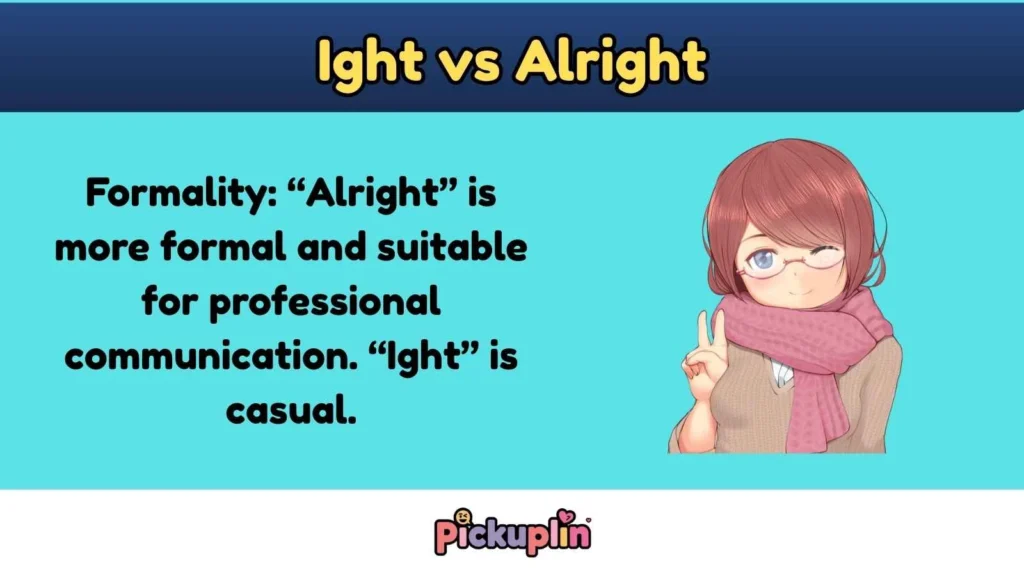
Although ight comes from “alright,” there are subtle differences in usage:
- Formality: “Alright” is more formal and suitable for professional communication. “Ight” is casual.
- Tone: “Ight” has a laid-back, friendly tone. “Alright” can sound neutral or formal.
- Medium: “Ight” is mostly used in texting, social media, and gaming. “Alright” appears in speech and formal writing.
Why People Prefer “Ight” 🔥
The popularity of “ight” can be attributed to:
- Short and quick to type 📱
- Casual, friendly tone 😊
- Widely recognized among younger audiences 🌐
- Fits well in memes, social media captions, and chats 😂
Synonyms and Related Words of “Ight” 🔄
Here are some other slang terms that convey similar meanings:
- “Aight” – Another variant spelling
- “Okay” – More universal and formal
- “K” – Short and casual
- “Bet” – Informal agreement, often in slang
Common Mistakes When Using “Ight” ❌
Even though “ight” is casual, misuse can confuse the reader. Avoid these mistakes:
- Using in professional emails 🏢
- Overusing in one conversation – it can seem lazy 💤
- Using without context – might be interpreted as dismissive 🙄
Fun Examples of “Ight” in Pop Culture 🎵
Many songs, memes, and social media posts have embraced “ight.” Here are examples:
- Rap lyrics often use “ight” to show agreement or acknowledgment 🎤
- Memes captioned with “Ight, imma head out” have gone viral 😂
- Gaming communities use “ight” to indicate readiness or strategy approval 🎮
How to Use “Ight” Properly
To use “ight” effectively, follow these tips:
- Know your audience: Use with friends or informal chats 👯
- Use in the right context: Agreement, acknowledgment, or casual farewell ✌️
- Don’t mix with formal language: Avoid professional emails or presentations ❌
“Ight” in Different Platforms 🌐
“Ight” behaves differently depending on the platform:
- Twitter: Quick acknowledgment in replies
- Instagram: Comment reactions and captions
- Snapchat: Informal, friendly chat usage
- Gaming chats: Indicates readiness or agreement in multiplayer games 🎮
Short Table: Quick Reference for “Ight” Usage 📊
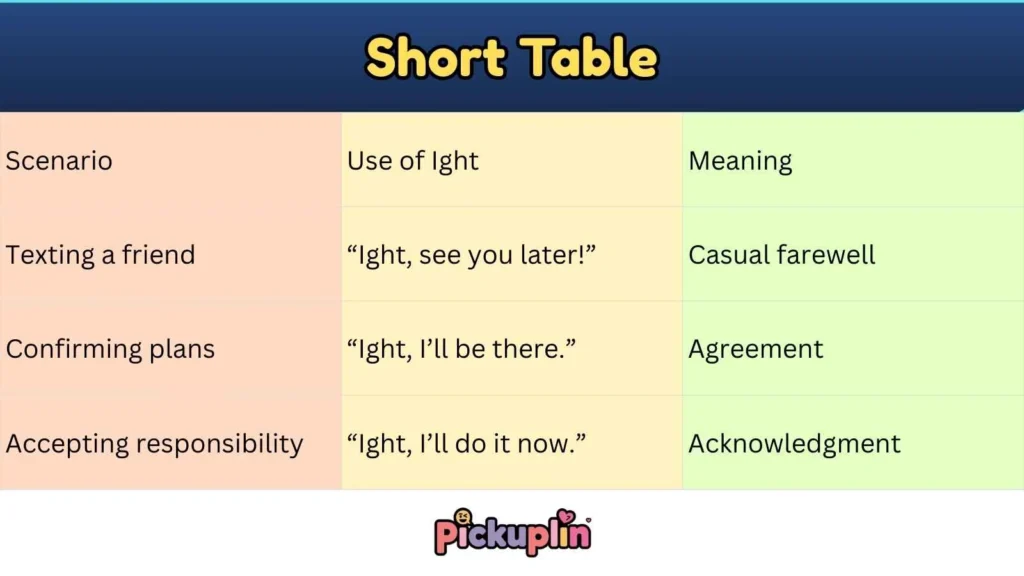
| Scenario | Use of Ight | Meaning |
|---|---|---|
| Texting a friend | “Ight, see you later!” | Casual farewell |
| Confirming plans | “Ight, I’ll be there.” | Agreement |
| Accepting responsibility | “Ight, I’ll do it now.” | Acknowledgment |
Related Slang You Should Know 💡
Understanding “ight” can help you navigate other slang terms:
- Bet meaning – Used for agreement or confirmation
- Sus meaning – Short for suspicious
- Lit meaning – Exciting or fun
Expert Tips on Using “Ight” 🧠
Here’s how to sound natural while using “ight”:
- Use it sparingly to maintain effect
- Pair with emojis for tone clarity 😎
- Observe how friends and online communities use it
- Combine with casual phrases like “imma” or “bet” for authenticity
FAQs
1. Is “ight” formal or informal?
“Ight” is informal and mainly used in texting, memes, or casual online conversations.
2. Can I use “ight” in professional messages?
No, it is best to use “alright” or “okay” in formal emails or workplace communication.
3. What’s the difference between “ight” and “aight”?
Both mean the same, but “aight” is another spelling variant. Usage depends on personal or regional preference.
4. Is “ight” a recent slang?
It became popular in the early 2000s through online chats, hip-hop culture, and memes, but its roots go back further in informal African American Vernacular English.
5. How do I pronounce “ight”?
It’s pronounced like “eye-t” or similar to “alright” with a shortened sound.
Conclusion
“Ight” is more than just a casual slang—it’s a reflection of modern digital communication. It’s quick, friendly, and widely recognized among younger audiences.
By understanding its meaning, origin, and proper usage, you can communicate naturally and confidently online. Remember, the key to using “ight” effectively is context, audience, and tone.
Now that you know the full ight meaning, start using it correctly in your chats, texts, and social media posts! 🚀

I’m the voice behind Pikuplin, where I simplify meanings, slang, and everyday expressions in a way that actually makes sense. I love breaking down words and phrases so readers can understand not just the definition, but the real meaning behind them. Every piece I write is based on clarity, curiosity, and real human understanding.