Have you ever experienced a moment so beautiful that it disappeared almost as soon as you noticed it? 😌 That feeling — brief, delicate, and impossible to hold — perfectly captures the fleeting meaning.
In everyday life, language, emotions, and even memories, the word fleeting appears more often than we realize. Understanding its meaning helps us better express time, feelings, and experiences that don’t last forever.
In this expert guide, we’ll explore the fleeting meaning in depth — including its origin, real-life examples, emotional usage, grammar forms, and cultural relevance — all explained in a simple, conversational way ✨.
What Is the Fleeting Meaning? 📘
The word fleeting means lasting for a very short time. Something fleeting appears briefly and then disappears quickly.
When we say something is fleeting, we emphasize its temporary nature. It could be a thought, emotion, opportunity, moment, or even a glance.
Simple definition:
Fleeting describes something that passes quickly and does not last long.
This word is often used to describe experiences that feel meaningful but vanish almost instantly 🌬️.
Origin and History of the Word Fleeting 🕰️
Understanding a word’s origin adds depth to its meaning, and fleeting is no exception.
The word comes from the Old English term “fleotan”, which means to float or drift away. Over time, this idea evolved into something that moves past quickly.
By the 14th century, fleeting was commonly used in English literature to describe time, life, and moments that vanish.
This historical background explains why the word still carries a poetic and emotional tone today 💭.
Fleeting Meaning in Simple Words 🧠
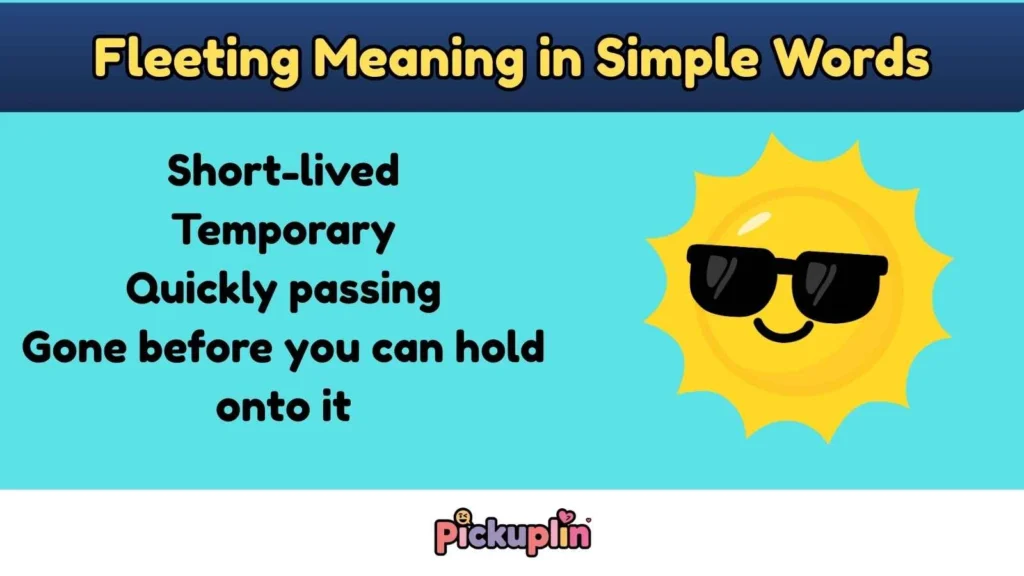
If we break it down into everyday language:
- Short-lived
- Temporary
- Quickly passing
- Gone before you can hold onto it
A fleeting thing does not stay. It comes, it goes, and sometimes leaves a memory behind.
How Fleeting Is Used in Everyday Language 🗣️
The word fleeting is commonly used in conversations, writing, and storytelling.
Common sentence examples:
- She gave him a fleeting smile before leaving.
- Happiness can feel fleeting during difficult times.
- It was just a fleeting moment, but I’ll remember it forever.
These examples show how the word adds emotional depth and clarity to short-lived experiences 🌸.
Fleeting Meaning in Emotional Contexts 💖
One of the most powerful uses of fleeting is in emotional expression.
We often describe feelings as fleeting when they appear suddenly and fade quickly — such as joy, doubt, excitement, or fear.
Examples:
- A fleeting feeling of happiness
- Fleeting sadness after bad news
- A fleeting sense of hope
Emotionally, the word reminds us that feelings are temporary and constantly changing 🌈.
Fleeting vs Similar Words ⚖️
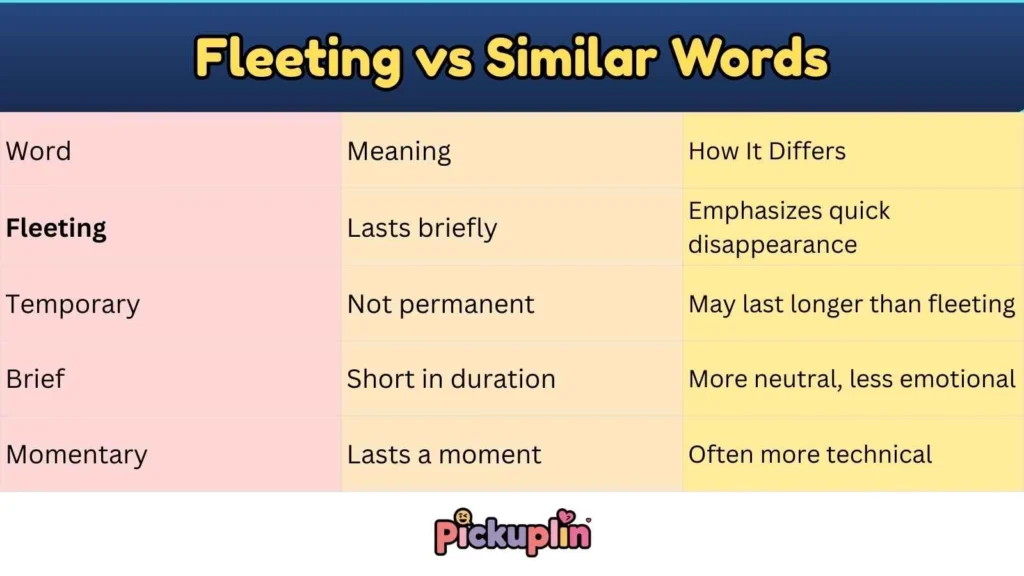
| Word | Meaning | How It Differs |
|---|---|---|
| Fleeting | Lasts briefly | Emphasizes quick disappearance |
| Temporary | Not permanent | May last longer than fleeting |
| Brief | Short in duration | More neutral, less emotional |
| Momentary | Lasts a moment | Often more technical |
Among these, fleeting feels the most poetic and emotionally expressive ✨.
Fleeting Meaning in Literature and Writing 📖
Writers love using the word fleeting because it captures the fragile nature of time and life.
“Life itself is fleeting, but memories give it meaning.”
In storytelling, fleeting moments often represent:
- Lost opportunities
- Temporary happiness
- The passage of time
- Human vulnerability
This makes the word a powerful tool for emotional storytelling ✍️.
Fleeting Moments in Real Life 🌍
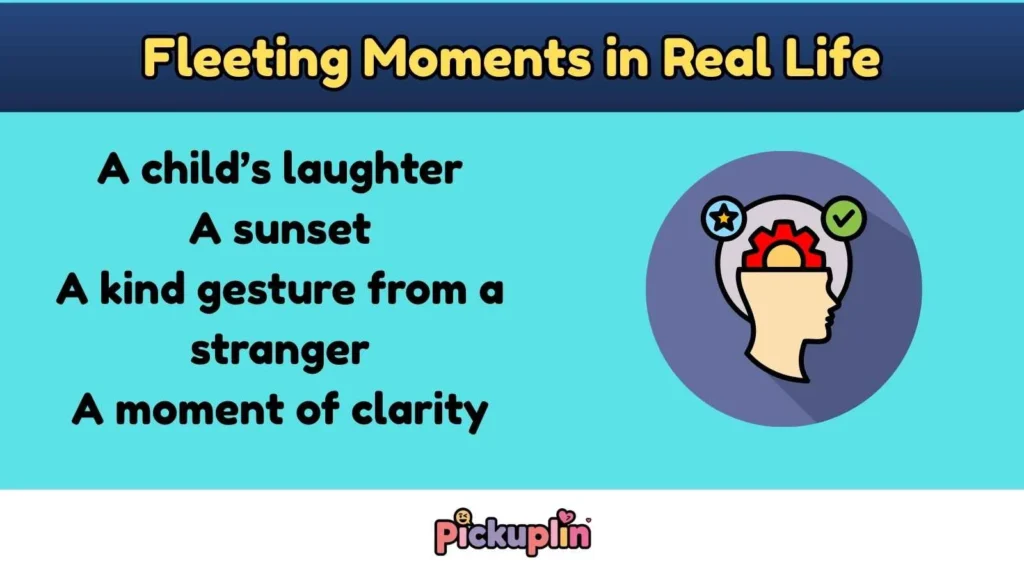
Many everyday experiences are fleeting, even though they feel significant.
- A child’s laughter
- A sunset
- A kind gesture from a stranger
- A moment of clarity
These moments remind us to stay present and appreciate what we have before it passes 💫.
Grammatical Forms of Fleeting ✏️
The word fleeting functions mainly as an adjective, but it has related forms.
- Fleeting (adjective): fleeting thought
- Fleetingly (adverb): smiled fleetingly
- Fleetingness (noun): the fleetingness of youth
Using these forms correctly improves clarity and fluency in writing.
Why the Fleeting Meaning Matters 🧩
Understanding the fleeting meaning helps us communicate more precisely and emotionally.
It reminds us that:
- Nothing lasts forever
- Moments deserve attention
- Change is natural
This awareness encourages mindfulness and emotional intelligence 🌱.
Common Mistakes When Using Fleeting ❌
Some people misuse the word by applying it to long-term situations.
Incorrect: A fleeting relationship that lasted ten years
Correct: A fleeting conversation at the café
Always use fleeting for things that truly pass quickly.
FAQs
1. What is the simplest meaning of fleeting?
Fleeting means something that lasts for a very short time.
2. Is fleeting positive or negative?
It can be both. Fleeting moments can be beautiful or disappointing, depending on context.
3. Can emotions be fleeting?
Yes. Many emotions appear briefly and then fade away.
4. Is fleeting formal or informal?
It works well in both everyday conversation and formal writing.
5. What is an example of a fleeting moment?
A smile from a stranger that disappears instantly.
Final Thoughts
The fleeting meaning captures one of life’s most powerful truths: nothing stays forever.
By understanding and using this word thoughtfully, we become better communicators and more mindful humans.
Sometimes, the most meaningful things are the ones that don’t last long — and that’s what makes them special 💖.

I’m the voice behind Pikuplin, where I simplify meanings, slang, and everyday expressions in a way that actually makes sense. I love breaking down words and phrases so readers can understand not just the definition, but the real meaning behind them. Every piece I write is based on clarity, curiosity, and real human understanding.