Language evolves fast. One day you’re texting normally, and the next day someone drops a word like “feining” in a chat—and suddenly you’re confused. 🤔
If you’ve searched for feining meaning, you’re not alone. This word shows up in social media captions, song lyrics, and text messages. However, it often gets mixed up with similar words like “feigning” or “feening.”
What Is the Feining Meaning?
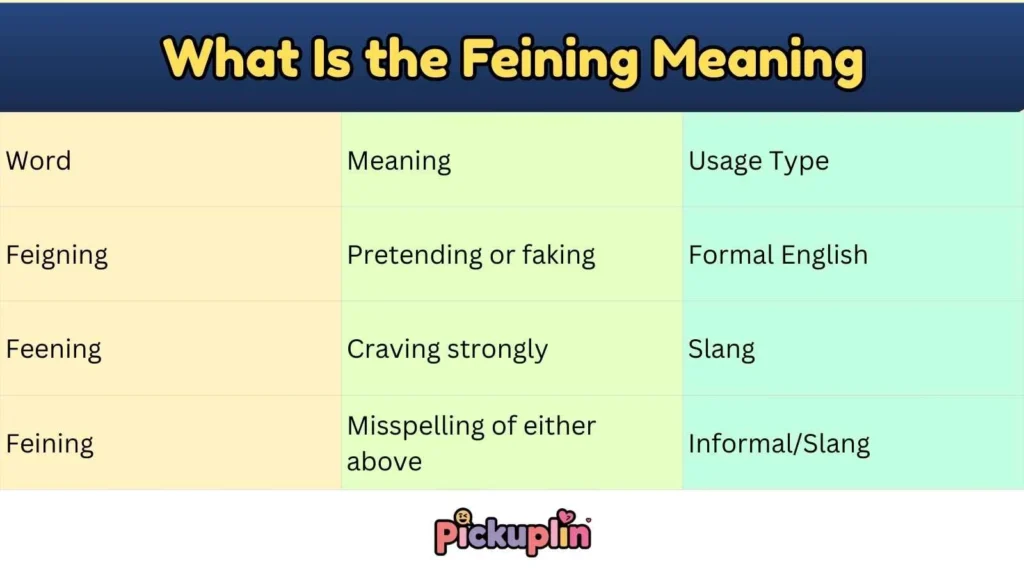
The term “feining” is commonly used as a slang variation of either:
- “Feigning” (pretending or faking something), or
- “Feening” (slang for craving something intensely)
However, in standard English dictionaries, “feining” is not officially recognized as a correct spelling. It usually appears as a misspelling or phonetic spelling in casual writing.
So the feining meaning depends heavily on context. 🔎
| Word | Meaning | Usage Type |
|---|---|---|
| Feigning | Pretending or faking | Formal English |
| Feening | Craving strongly | Slang |
| Feining | Misspelling of either above | Informal/Slang |
Is “Feining” a Real Word?
Short answer: No, not in standard English. ❌
But language isn’t just about dictionaries. It’s about how people communicate. On social media, many users spell words based on sound. As a result, “feining” often replaces:
- Feigning (correct spelling)
- Feening (urban slang spelling)
This happens because English pronunciation can be confusing. Words that sound similar often get spelled incorrectly in informal spaces.
“Spelling evolves in digital spaces. Informal writing often prioritizes sound over rules.”
Feining vs Feigning: Understanding the Difference
This is where most confusion happens. Let’s break it down clearly. 👇
Feigning Meaning (Correct Spelling)
Feigning means pretending to feel or do something.
Example:
- She was feigning surprise at the party.
- He is feigning illness to skip school.
This is proper English and used in professional writing.
Feining Meaning (Common Misspelling)
When people write “feining,” they usually mean “feigning.” However, the spelling is incorrect in formal writing.
If you’re writing professionally, always use feigning.
Feining vs Feening: Slang Confusion Explained
Now let’s look at another possibility. 👀
In urban slang, “feening” means craving something badly.
Examples:
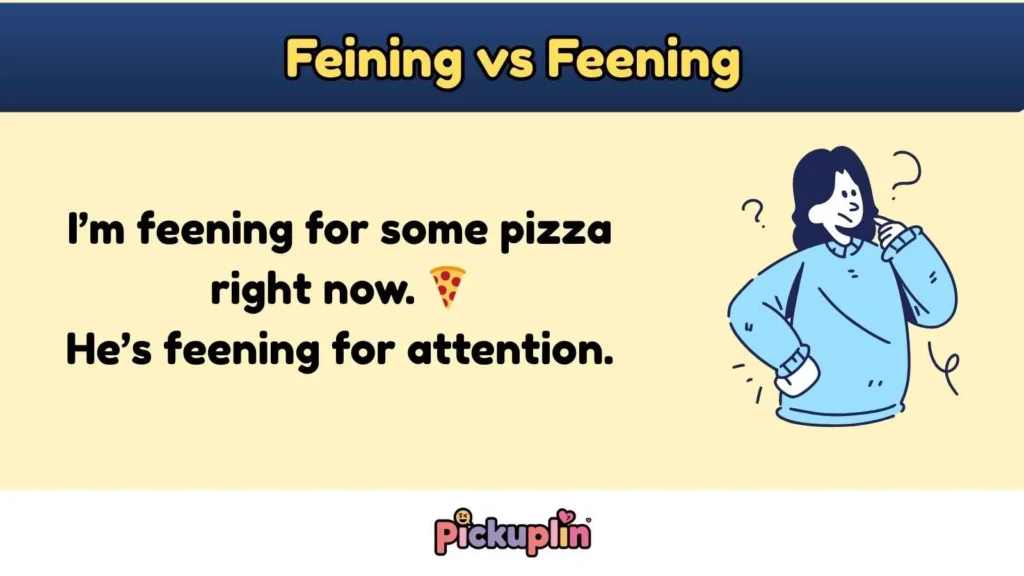
- I’m feening for some pizza right now. 🍕
- He’s feening for attention.
Here, it means strong desire or addiction-like craving.
Sometimes, people spell it as “feining” by mistake. That’s why context matters so much when understanding the feining meaning.
Origin of the Word Feigning
The correct root word, feign, comes from older European language forms meaning:
- To invent
- To pretend
- To shape artificially
Over time, it became part of standard English vocabulary. The spelling remained consistent in formal writing, but digital slang created variations like “feining.”
Why “Feining” Became Popular Online 📱
Social media changed spelling habits. Fast typing, autocorrect errors, and phonetic spelling all contribute.
Here’s why “feining” appears often:
- Sounds identical to “feigning” when spoken
- People type quickly in texts
- Autocorrect sometimes alters slang words
- Users prioritize speed over grammar
As a result, the feining meaning became widely searched online.
How to Use Feining Correctly (If You Should)
If you’re writing:
- Academic papers ❌
- Professional emails ❌
- Blog posts ✅ (only when explaining slang)
- Text messages ✅ (casual use)
For clarity and authority, always choose the correct spelling based on your meaning.
Real-Life Examples of Feining in Context
Let’s look at how people actually use it online.
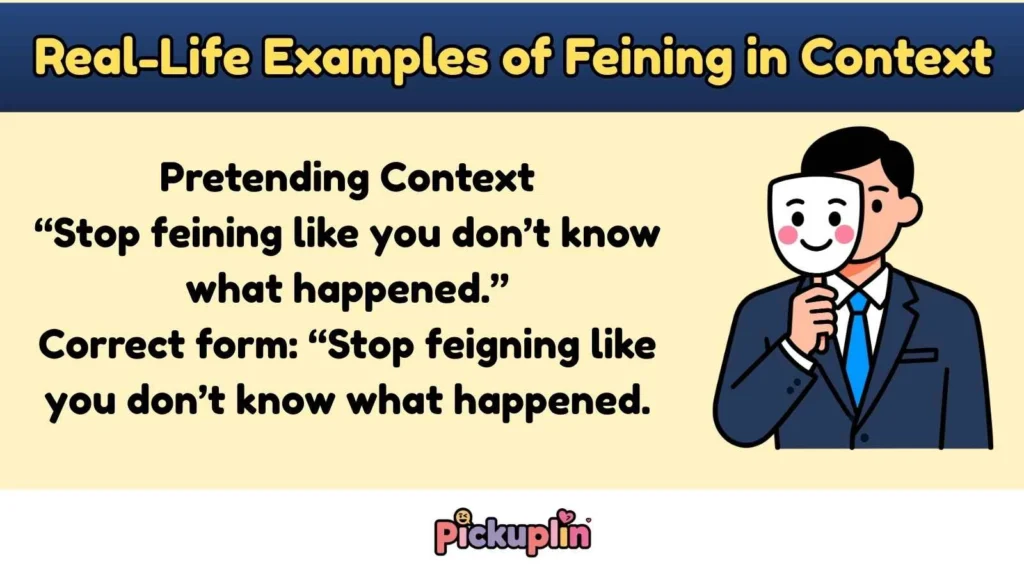
Example 1: Pretending Context
“Stop feining like you don’t know what happened.”
Correct form: “Stop feigning like you don’t know what happened.”
Example 2: Craving Context
“I’m feining for chocolate.”
Correct slang form: “I’m feening for chocolate.”
Common Mistakes People Make
- Using “feining” in formal essays
- Confusing craving with pretending meanings
- Assuming it’s dictionary-approved
- Overusing slang in professional content
Understanding the correct feining meaning helps avoid embarrassment in formal settings. 👍
When Should You Avoid Using “Feining”?
Avoid it in:
- Business communication
- Academic writing
- Professional websites
- Legal documents
Stick to feigning or properly spelled feening depending on context.
Quick Definition for Featured Snippet
Feining meaning: “Feining” is an informal or misspelled variation of “feigning” (pretending) or “feening” (craving something strongly). It is not officially recognized in standard English dictionaries.
FAQs
1. Is feining a real English word?
No, “feining” is not officially recognized. It is usually a misspelling of “feigning” or slang variation of “feening.”
2. What does feining mean in slang?
In slang context, it often means craving something badly, similar to “feening.”
3. What is the correct spelling: feining or feigning?
The correct formal spelling is feigning when meaning pretending.
4. Can I use feining in professional writing?
No. Always use the correct dictionary spelling for professional credibility.
Conclusion:
Language changes quickly, especially online. The feining meaning depends entirely on context. Most often, it’s a misspelling of either:
- Feigning (pretending)
- Feening (craving intensely)
For professional writing, stick with correct spelling. For casual texting, slang variations are common—but know the difference.
Understanding word usage builds credibility. It improves communication. And it prevents confusion. ✨

I’m the voice behind Pikuplin, where I simplify meanings, slang, and everyday expressions in a way that actually makes sense. I love breaking down words and phrases so readers can understand not just the definition, but the real meaning behind them. Every piece I write is based on clarity, curiosity, and real human understanding.