Entendre meaning is one of those language concepts that sounds complex at first but becomes fascinating once you truly understand it 😊.
Words are powerful, and sometimes a single phrase can carry more than one meaning at the same time. That layered meaning is exactly where the concept of entendre lives.
Whether you’ve heard this term in English class, comedy, literature, or everyday conversation, understanding the entendre meaning helps you become a sharper reader, listener, and communicator.
In this guide, we’ll break it all down in a simple, friendly, expert way—no confusion, no fluff, just clarity ✨.
What Does Entendre Mean?
The word entendre refers to a phrase or expression that can be understood in more than one way. Usually, one meaning is obvious and innocent, while the other is hidden or subtle.
In simple terms:
Entendre meaning: a statement that has two interpretations, often used for cleverness, humor, or emphasis.
The most common form you’ll hear is double entendre, but “entendre” on its own still carries the idea of layered meaning 🎭.
Origin and History of the Word Entendre
The term entendre comes from the French language, where it means “to understand”. Over time, English adopted the phrase, especially in literature and rhetoric.
Historically, writers and speakers used entendre to:
- Add depth to dialogue
- Create subtle humor 😄
- Avoid saying something directly
- Engage intelligent audiences
Classic literature, theater, and poetry often relied on entendre to communicate ideas that couldn’t be said openly.
What Is a Double Entendre?
A double entendre is a specific type of entendre where a phrase has two meanings—one literal and one implied.
Usually:
- The first meaning is harmless
- The second meaning is clever, ironic, or suggestive
This is why double entendre is so popular in comedy, storytelling, and pop culture 🎬.
Simple Entendre Examples (Easy to Understand)
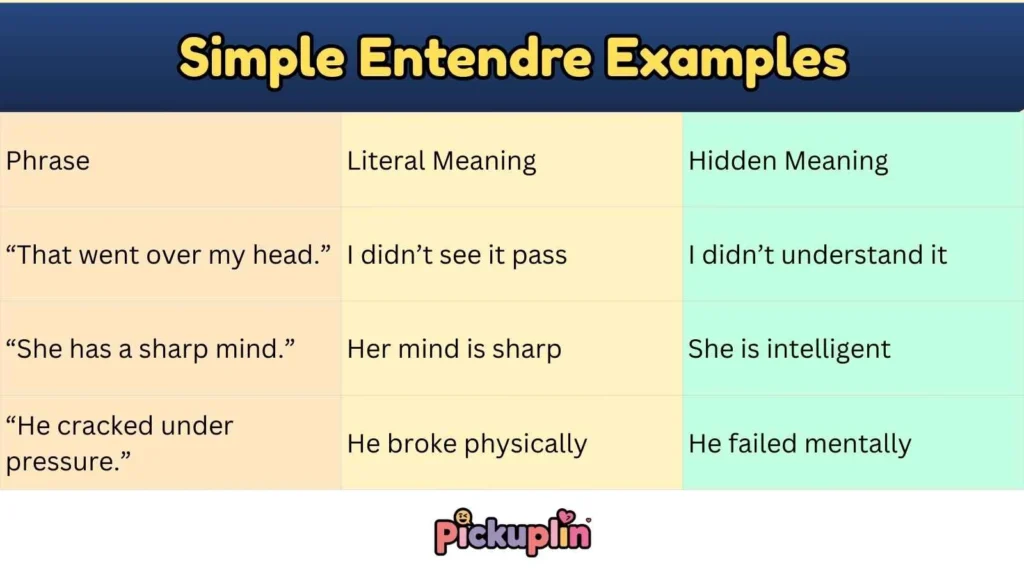
Let’s look at a few clean, everyday examples to understand the entendre meaning clearly:
| Phrase | Literal Meaning | Hidden Meaning |
|---|---|---|
| “That went over my head.” | I didn’t see it pass | I didn’t understand it |
| “She has a sharp mind.” | Her mind is sharp | She is intelligent |
| “He cracked under pressure.” | He broke physically | He failed mentally |
Each phrase works on two levels, which is the heart of entendre ✨.
Types of Entendre in Language
1. Literal vs Figurative Entendre
This type contrasts a physical meaning with a symbolic one.
Example: “Breaking the ice” ❄️
- Literal: Breaking actual ice
- Figurative: Starting a conversation
2. Humorous Entendre
Often used in jokes and comedy, this type relies on timing and wordplay.
3. Literary Entendre
Authors use entendre to add emotional depth and hidden themes to their writing 📚.
4. Conversational Entendre
Everyday speech is full of unintended entendre, especially idioms and expressions.
Why Understanding Entendre Meaning Matters
Understanding entendre helps you:
- Improve reading comprehension
- Understand jokes and sarcasm 😄
- Write more creatively
- Communicate with clarity and confidence
It also sharpens critical thinking, which is a valuable life skill.
Entendre in Literature and Storytelling
Writers often rely on entendre to:
- Foreshadow events
- Develop characters
- Add emotional layers
“Good writing says more than it appears to say.”
This hidden depth keeps readers engaged and thinking long after they finish reading 📖.
Entendre vs Similar Language Devices
| Term | Meaning | Difference |
|---|---|---|
| Entendre | Two meanings | Focuses on interpretation |
| Metaphor | Symbolic comparison | Single deeper meaning |
| Irony | Opposite of expectation | Context-based contrast |
How Entendre Is Used in Modern English
Today, entendre appears in:
- Movies and TV shows 🎥
- Social media captions
- Song lyrics
- Advertising slogans
People enjoy language that makes them think. Entendre does exactly that.
How to Identify an Entendre in a Sentence
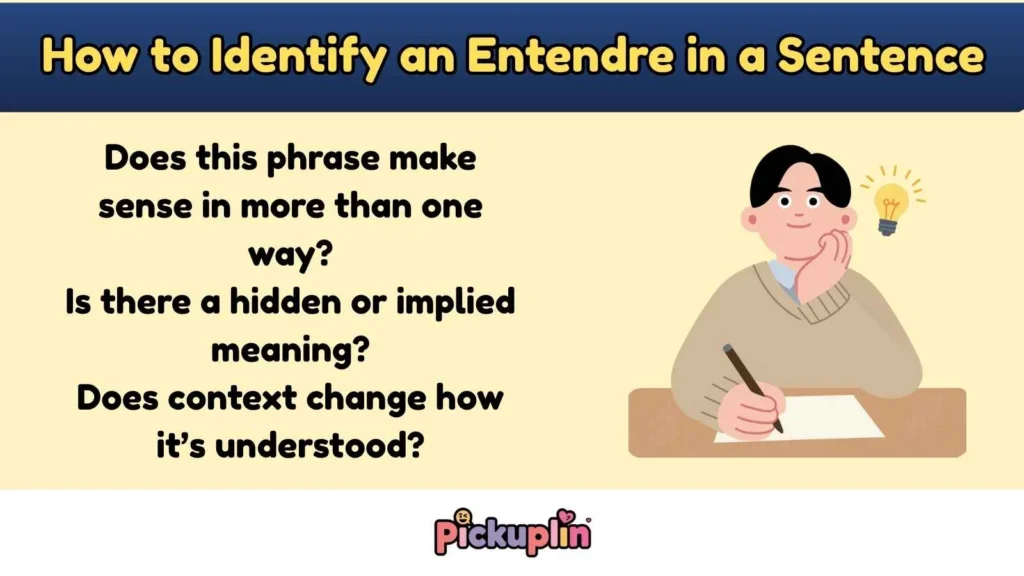
Ask yourself:
- Does this phrase make sense in more than one way?
- Is there a hidden or implied meaning?
- Does context change how it’s understood?
If yes, you’ve likely found an entendre 👀.
Common Misunderstandings About Entendre
- Entendre is not always intentional
- It is not limited to humor
- It doesn’t have to be complicated
Many people use entendre without even realizing it.
FAQs
What is the simplest definition of entendre?
An entendre is a phrase that can be understood in two different ways.
Is entendre the same as double entendre?
Double entendre is a common type of entendre, but not the only one.
Is entendre used only in literature?
No, it appears in everyday speech, media, and writing.
Can an entendre be unintentional?
Yes, sometimes meanings overlap without the speaker realizing it.
Why do writers use entendre?
To add depth, creativity, and engagement to their work.
Final Thoughts
Understanding the entendre meaning opens a new door into how language works 🧠. It teaches us that words are not just tools for communication—they are layered, expressive, and powerful.
Once you start noticing entendre, you’ll see it everywhere. Conversations become richer. Writing becomes sharper. And language becomes more fun.

I’m the voice behind Pikuplin, where I simplify meanings, slang, and everyday expressions in a way that actually makes sense. I love breaking down words and phrases so readers can understand not just the definition, but the real meaning behind them. Every piece I write is based on clarity, curiosity, and real human understanding.