Have you ever sent a message and received a short reply that simply said, “Duly noted.”? 🤔 It feels formal. It feels final. Sometimes it even feels… a little cold.
If you’ve searched for the duly noted meaning, you’re not alone.
This phrase appears in emails, meetings, academic discussions, and even casual chats.
Yet many people struggle to understand its exact tone and intention.
What Does Duly Noted Mean? (Clear Definition) 📘
The duly noted meaning is simple but powerful.
Duly noted means “properly acknowledged” or “officially recorded and understood.”
The word “duly” means in a proper manner or as required. The word “noted” means observed, recorded, or acknowledged.
Together, the phrase indicates that:
- The message has been received ✅
- The information is acknowledged 📌
- It has been officially recognized 📝
However, tone depends on context. Sometimes it sounds professional. Other times, it may sound dismissive.
Breaking Down the Phrase: Word-by-Word Meaning 🔍
What Does “Duly” Mean?
Duly is an adverb. It suggests something was done correctly, appropriately, or according to rules.
Examples:
- “The form was duly signed.”
- “She was duly informed.”
What Does “Noted” Mean?
Noted means recognized, recorded, or observed.
For example:
- “Your suggestion has been noted.”
- “The issue was noted during the meeting.”
When combined, the duly noted meaning becomes a formal acknowledgment statement.
Origin and History of “Duly Noted” 📜

The phrase developed in formal administrative and legal communication.
Historically, officials needed a short phrase to confirm information was recorded properly. Instead of writing long explanations, they used concise acknowledgments like:
- “Noted.”
- “Duly recorded.”
- “Duly noted.”
Over time, the phrase entered business emails and corporate communication. Today, it remains widely used in professional settings.
How Is “Duly Noted” Used in Emails? 📧
The duly noted meaning becomes especially important in workplace communication.
Here’s how it appears in emails:
Professional Acknowledgment
“Your concerns regarding the timeline are duly noted.”
Neutral Response
“Duly noted. We will review this further.”
Firm or Final Tone
“Your objection is duly noted.”
Notice how tone changes depending on context and punctuation.
Is “Duly Noted” Polite or Rude? 🤨
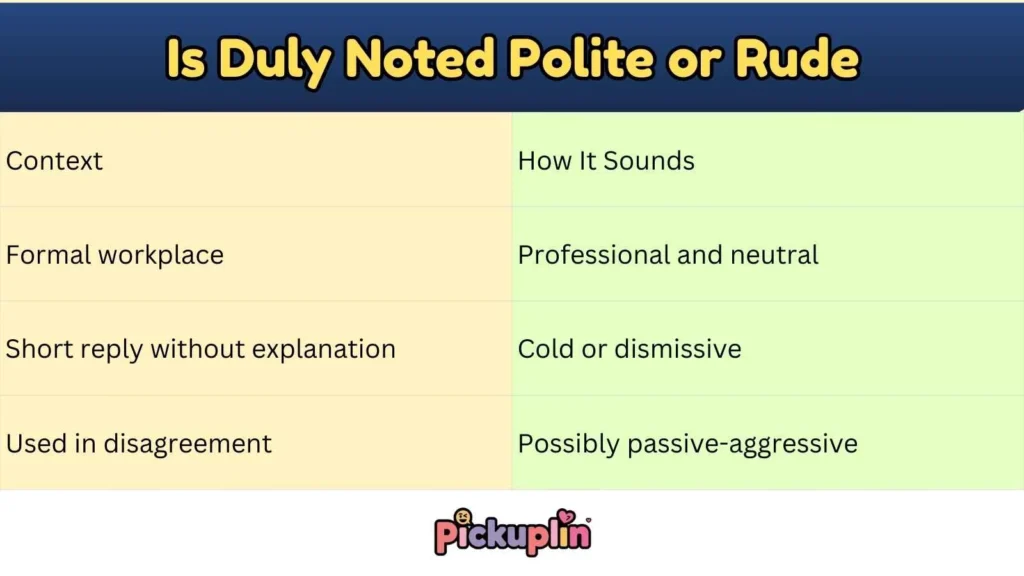
This is one of the most searched questions related to the duly noted meaning.
| Context | How It Sounds |
|---|---|
| Formal workplace | Professional and neutral |
| Short reply without explanation | Cold or dismissive |
| Used in disagreement | Possibly passive-aggressive |
💡 Tip: If you want to sound warmer, add a follow-up sentence.
Example:
“Duly noted. Thank you for highlighting this issue.”
Examples of “Duly Noted” in Sentences ✍️
Here are practical examples showing the duly noted meaning in action:
- “Your feedback has been duly noted and will be discussed.”
- “The change request is duly noted.”
- “Duly noted. We’ll implement the update.”
- “Your complaint was duly noted in our system.”
Each sentence confirms acknowledgment without promising action.
When Should You Use “Duly Noted”? ✅
Use it when you need to:
- Acknowledge formal communication
- Confirm receipt of instructions
- Record feedback professionally
- Respond in structured environments
It works well in:
- Corporate emails 🏢
- Academic discussions 🎓
- Official notices 📄
- Project management updates 📊
When Should You Avoid It? 🚫
Avoid using the phrase if:
- You want to sound friendly or casual
- The situation is emotional
- The message requires empathy
- You want to show appreciation
Instead of saying “Duly noted” after someone shares a personal concern, try:
“Thank you for sharing this. I understand your concern.”
Polite Alternatives to “Duly Noted” 💬
Sometimes you need variety. Here are professional alternatives:
- “Acknowledged.”
- “Understood.”
- “I’ve taken note.”
- “Thank you for the clarification.”
- “I appreciate the update.”
Common Misunderstandings About the Phrase ⚠️
Many people assume that duly noted means agreement. It does not.
And It only confirms acknowledgment.
It does not promise:
- Approval
- Implementation
- Agreement
- Immediate action
This subtle difference explains why tone matters so much.
Duly Noted vs Noted: What’s the Difference? 🔎
| Phrase | Meaning | Tone |
|---|---|---|
| Noted | Seen or acknowledged | Very brief |
| Duly Noted | Properly acknowledged | More formal |
Adding “duly” increases formality and professionalism.
Psychological Impact in Communication 🧠

The duly noted meaning may seem simple, but psychologically it signals authority and control.
Why?
- It confirms awareness.
- It closes discussion quickly.
- It limits emotional engagement.
Leaders often use it to maintain structure and efficiency.
FAQs
1. Is “duly noted” formal?
Yes. It is commonly used in professional and official communication.
2. Does “duly noted” mean I agree?
No. It only means the information has been acknowledged.
3. Can I use it in casual conversations?
It’s possible, but it may sound overly formal or sarcastic.
4. Is it passive-aggressive?
It can sound that way if used without warmth or context.
5. What is the best alternative?
“Acknowledged” or “Understood” are neutral and clear options.
Conclusion:
Understanding the duly noted meaning helps you communicate with clarity and professionalism.
Remember:
- It means properly acknowledged.
- It does not imply agreement.
- It works best in formal settings.
- Tone depends on context.
Language shapes perception. A small phrase like “duly noted” can influence how others view your response.
If you found this guide helpful, explore more expert breakdowns of common phrases and expressions to sharpen your communication skills. 🚀

I’m the voice behind Pikuplin, where I simplify meanings, slang, and everyday expressions in a way that actually makes sense. I love breaking down words and phrases so readers can understand not just the definition, but the real meaning behind them. Every piece I write is based on clarity, curiosity, and real human understanding.