Have you ever come across the word “discrete” and wondered what it truly means? 🤔 Whether in school, writing, or casual conversation, understanding this word can elevate your language skills and make you sound precise and knowledgeable.
In this guide, we’ll explore the discrete meaning, its origin, common usage, examples, and much more. By the end, you’ll master the word like an expert! 💡
What Does “Discrete” Mean? 🔍
The word discrete is often confused with “discreet”, but they are very different. “Discrete” means something that is separate, distinct, or individually separate from others. It emphasizes individuality and distinction rather than secrecy.
- Example: The teacher divided the class into discrete groups for the project.
- Example: Data points in this study are discrete and easy to analyze individually.
Discrete vs. Discreet: Common Confusion ⚠️
Many learners confuse discrete with discreet. Remember:
- Discrete: Separate, distinct, individual.
- Discreet: Careful, tactful, subtle.
Tip: If you’re talking about separation or individuality, it’s discrete. If you’re talking about caution or secrecy, it’s discreet.
Origin of the Word “Discrete” 🌍
The word discrete comes from the Latin discretus, meaning “separated” or “distinct.” It entered the English language in the late 14th century. Over time, it became widely used in mathematics, science, and everyday English to indicate separation or individuality.
Different Contexts Where “Discrete” is Used 📝
1. In Mathematics ➗
In math, discrete refers to things that can be counted separately, such as integers or distinct elements.
- Example: A computer processes discrete signals instead of continuous waves.
- Example: The number of students in a class is a discrete variable.
2. In Science 🔬
Scientists use discrete to describe distinct entities or categories.
- Example: The experiment measured discrete energy levels of atoms.
- Example: Cells were classified into discrete types based on their structure.
3. In Everyday Language 🗣️
In regular conversation, discrete helps describe things that are separate or individually noticeable.
- Example: He kept his hobbies in discrete journals for each activity.
- Example: The store arranged its products in discrete sections for easier shopping.
Synonyms of Discrete ✅
Using synonyms helps vary your writing while keeping the meaning clear. Some common synonyms include:
- Distinct
- Separate
- Individual
- Isolated
- Detached
Antonyms of Discrete ❌
Antonyms highlight the opposite meaning of “discrete.” Examples include:
- Continuous
- Connected
- Integrated
- Combined
- Unified
Discrete in Sentences: Practical Examples ✍️
Here are some real-world sentences that show discrete in action:
- The museum displays the artifacts in discrete galleries by era.
- Discrete data points make statistical analysis simpler and more accurate.
- Each department in the company operates as a discrete unit.
- The festival had discrete stages for music, art, and food.
Using Discrete in Academic Writing 📖
In essays, research papers, and reports, using discrete can make your language precise and professional.
- Tip: Avoid confusing it with “discreet” in formal writing.
- Tip: Use it when discussing categories, counts, or distinct elements.
Tables for Clear Understanding 📊
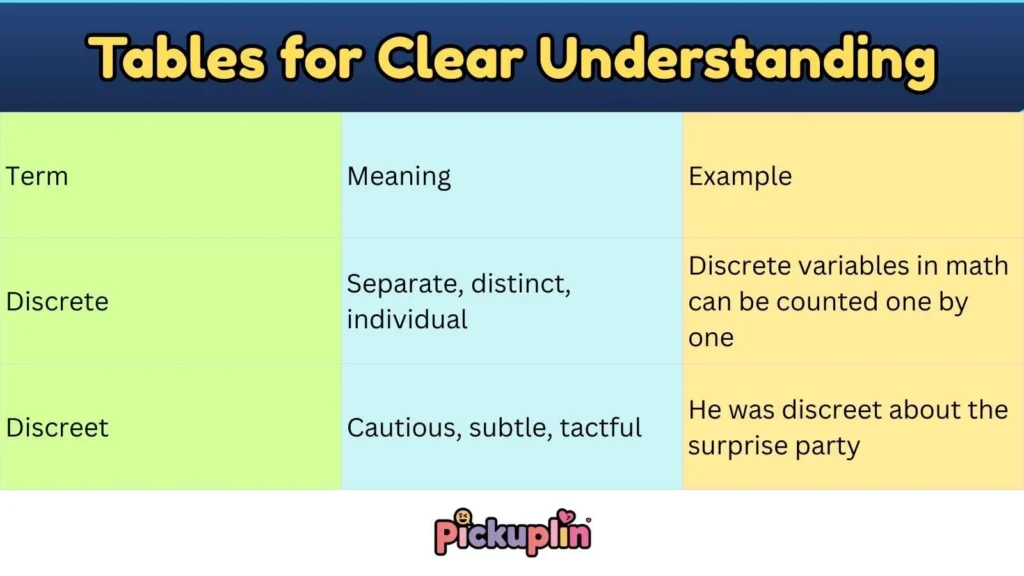
| Term | Meaning | Example |
|---|---|---|
| Discrete | Separate, distinct, individual | Discrete variables in math can be counted one by one |
| Discreet | Cautious, subtle, tactful | He was discreet about the surprise party |
Common Mistakes When Using Discrete ❌
- Using discrete when you mean discreet.
- Overusing the word in informal contexts where simpler terms like “separate” would work.
- Confusing it with continuous or connected elements.
How to Remember the Meaning of Discrete 🧠
Try these memory tips:
- Think separation: Discrete = distinct, individual.
- Math trick: Discrete numbers are countable.
- Spelling tip: “Discrete” has a “t” for “totally separate.”
Discrete in Technology & Computing 💻
In tech, “discrete” appears in electronics, data, and computing:
- Example: Discrete graphics cards are separate from the motherboard.
- Example: Digital signals are discrete, unlike continuous analog signals.
Psychology & Social Science Context 🧩
Social scientists use discrete to describe categories or behaviors:
- Example: Participants were assigned to discrete groups for the survey.
- Example: Emotions can be categorized into discrete types like joy, sadness, or anger.
Fun Facts About Discrete 🎉
- The word has been in English for over 600 years!
- It’s commonly used in STEM fields but is also perfect for everyday English.
- Many people confuse it with “discreet,” making it a favorite word in vocabulary quizzes.
FAQs
1. What is the difference between discrete and continuous?
Discrete refers to separate, countable units, while continuous refers to unbroken, flowing quantities.
2. Can discrete be used in everyday conversation?
Yes! You can describe objects, groups, or ideas as discrete to emphasize separation.
3. How do I remember discrete vs discreet?
Discrete = distinct (think separate). Discreet = careful (think subtle).
4. Is discrete formal or informal?
It is neutral and works in both formal writing and casual speech when used correctly.
Conclusion:
Understanding the discrete meaning empowers you to use language with precision and clarity.
Whether in mathematics, science, writing, or conversation, mastering this word ensures you communicate effectively and professionally.
Remember the key: discrete = separate and distinct, not discreet! 🌟

I’m the voice behind Pikuplin, where I simplify meanings, slang, and everyday expressions in a way that actually makes sense. I love breaking down words and phrases so readers can understand not just the definition, but the real meaning behind them. Every piece I write is based on clarity, curiosity, and real human understanding.