Bon appetit meaning is one of those phrases you’ve probably heard many times—at dinner tables, in movies, or on cooking shows. But have you ever paused to truly understand what it means, where it comes from, and how to use it correctly? 🤔
This simple yet elegant expression carries more cultural depth than most people realize. It’s not just about food. It’s about good wishes, shared experiences, and human connection.
In this in-depth guide, we’ll explore the meaning of “bon appetit” from every possible angle—origin, pronunciation, examples, etiquette, and modern usage—written clearly and naturally for real readers.
Whether you’re a language learner, food lover, or just curious, this article will give you expert-level clarity in an easy, friendly way.
What Does Bon Appetit Mean? (Simple Explanation) 🍲
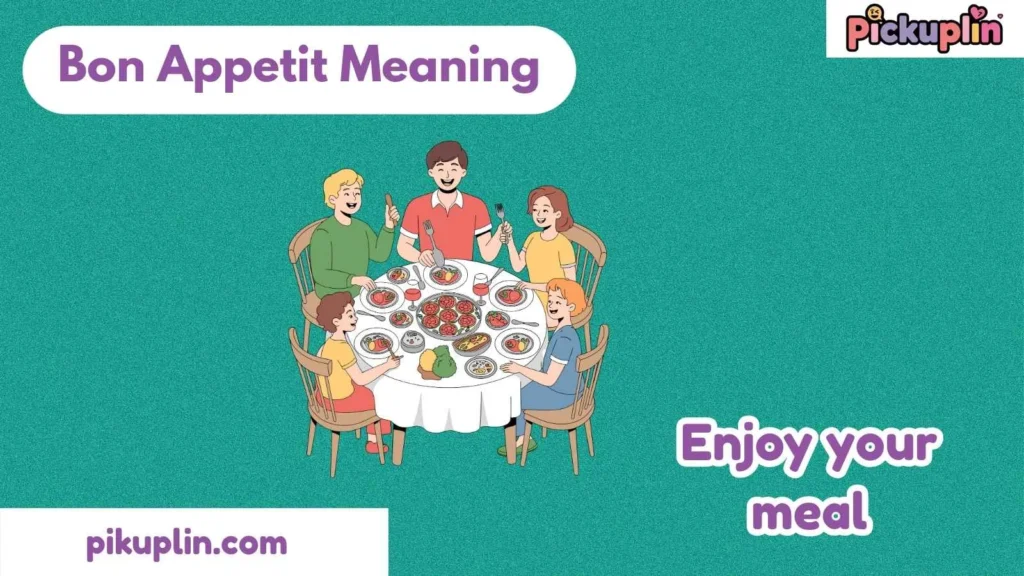
The phrase bon appetit means:
“Enjoy your meal” or “Have a good appetite.”
It is used to wish someone pleasure and enjoyment before they start eating. The phrase comes from the French language, but today it is widely used in English and many other languages.
In everyday conversation, saying “bon appetit” is a polite and friendly gesture. It shows care, warmth, and hospitality—especially when serving food or sitting down to eat together.
Even if you’re not in France, using this phrase adds a touch of elegance and global culture 🌍
Origin of Bon Appetit 🏛️
To fully understand the bon appetit meaning, we need to look at its roots.
The phrase comes from French:
- Bon = good
- Appétit = appetite
When combined, it literally translates to “good appetite.”
In French culture, food is deeply respected. Meals are seen as moments to slow down, connect, and enjoy life. Saying “bon appétit” before eating is a long-standing tradition that reflects this mindset.
Over time, the phrase traveled beyond France and became a globally recognized expression—especially in English-speaking countries.
Bon Appetit Meaning in English Usage 🇬🇧🇺🇸
In English, bon appetit is considered a borrowed or “loan” phrase. It keeps its original spelling and pronunciation but fits naturally into English conversations.
English speakers commonly use it:
- Before starting a meal
- When serving food to guests
- In restaurants or cafés
- In cooking shows and food blogs
Although English already has phrases like “enjoy your meal,” “bon appetit” feels more stylish, warm, and international.
Correct Pronunciation of Bon Appetit 🔊
Pronouncing it correctly adds confidence and authenticity.
Common pronunciation :
bon ah-peh-TEE
Helpful tips:
- The “t” at the end is usually silent or very soft
- Stress is on the last syllable: -tit
- Say it smoothly, not rushed
Don’t worry about being perfect. Even native English speakers use a relaxed pronunciation—and that’s completely fine 😊
When Should You Say Bon Appetit? ⏰
Timing matters when using this phrase.
You should say bon appetit:
- Right before someone starts eating
- When food is served
- As a polite gesture at the table
You should not say it:
- After the meal is already finished
- Randomly without food context
Think of it as a warm “go ahead and enjoy” moment 🍽️
Bon Appetit in Different Cultures 🌎
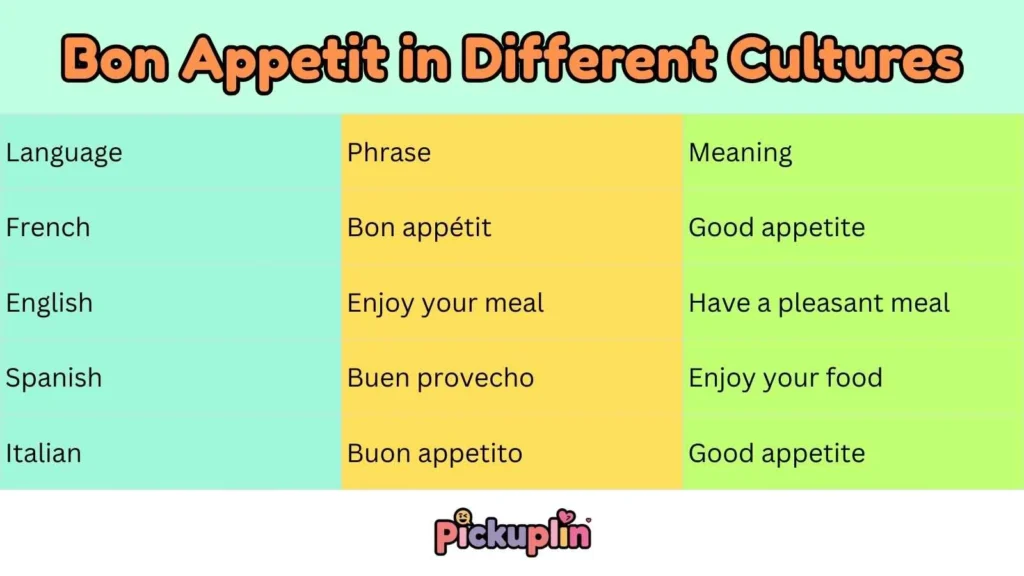
Many cultures have their own version of “bon appetit.” Here’s a quick comparison:
| Language | Phrase | Meaning |
|---|---|---|
| French | Bon appétit | Good appetite |
| English | Enjoy your meal | Have a pleasant meal |
| Spanish | Buen provecho | Enjoy your food |
| Italian | Buon appetito | Good appetite |
This shows how universal the idea is—food brings people together ❤️
Real-Life Examples of Bon Appetit 🍝
Understanding the bon appetit meaning becomes easier with examples.
1 Example (Home):
“Dinner is ready! Bon appetit, everyone.”
2 Example (Restaurant):
The waiter smiled and said, “Bon appetit.”
3 Example (Text Message):
“Your food just arrived? Bon appetit 😄”
As you can see, it works in both formal and casual situations.
Is Bon Appetit Formal or Informal? 🤝
The beauty of this phrase is its flexibility.
Formal use:
- Fine dining restaurants
- Business dinners
- Hosting guests
Informal use:
- Family meals
- Friends hanging out
- Text messages
It fits almost any food-related situation without sounding awkward.
Bon Appetit vs Enjoy Your Meal ⚖️
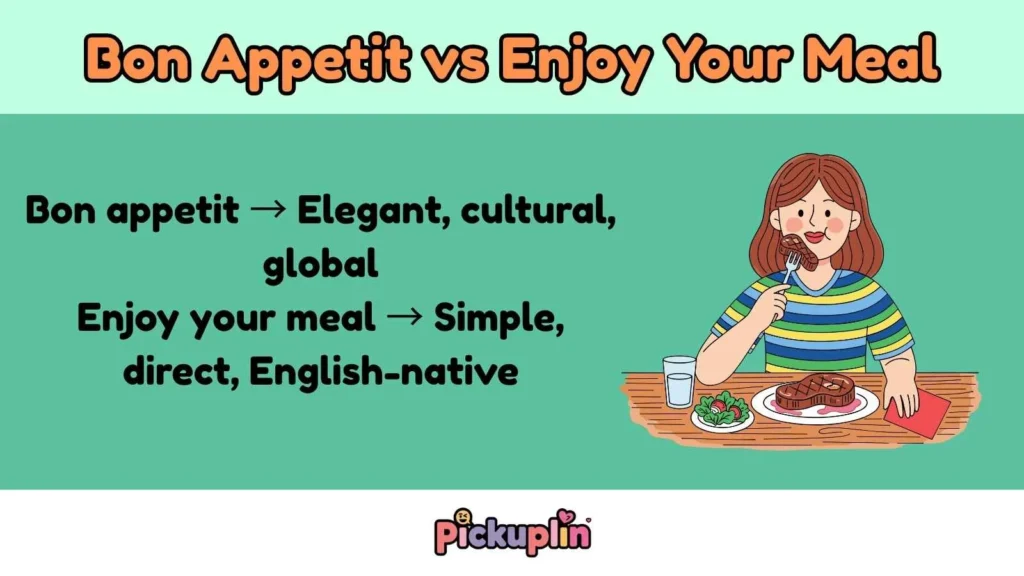
While both phrases have similar meanings, their tone is slightly different.
- Bon appetit → Elegant, cultural, global
- Enjoy your meal → Simple, direct, English-native
Choosing one depends on your personal style and setting.
Common Mistakes to Avoid ❌
Even simple phrases can be misused.
Avoid these mistakes:
- Saying it after eating
- Spelling it as “bon appetite” ❌
- Using it without food context
The correct spelling is always bon appetit.
Bon Appetit in Media and Pop Culture 🎬
You’ve probably seen this phrase used in:
- Cooking shows
- Food blogs
- Movies and TV series
Its frequent appearance has helped make the bon appetit meaning familiar worldwide.
Why Bon Appetit Feels So Polite 💬
This phrase works because it does three things:
- Shows respect
- Creates warmth
- Encourages enjoyment
Small words can create big emotional impact—and this is a perfect example.
FAQ
1. Is bon appetit French or English?
It is originally French but commonly used in English.
2. Can I say bon appetit in text messages?
Yes, it’s perfectly fine and often used casually.
3. Is it rude not to say bon appetit?
No, but saying it is considered polite and thoughtful.
4. What is the correct spelling?
The correct spelling is bon appetit.
5. Can I say it to myself?
Yes! Many people say it playfully before eating alone 😊
Final Thoughts:
The bon appetit meaning goes far beyond words. It’s a symbol of kindness, culture, and shared human experience. Whether spoken at a family table or typed in a message, it carries warmth and goodwill.
Now that you understand its origin, usage, and etiquette, you can use it with confidence and clarity.
Bon appetit—and enjoy every bite of knowledge and food alike! 🍽️

I’m the voice behind Pikuplin, where I simplify meanings, slang, and everyday expressions in a way that actually makes sense. I love breaking down words and phrases so readers can understand not just the definition, but the real meaning behind them. Every piece I write is based on clarity, curiosity, and real human understanding.