Have you ever wondered what it truly means when someone receives accolades? 🏆 Whether in school, work, or life, accolades are more than just words—they are symbols of achievement, respect, and recognition.
In this comprehensive guide, we’ll dive deep into the meaning of accolades, explore their origins, types, and provide real-world examples to help you understand their significance.
By the end, you’ll see why accolades matter in shaping success and self-confidence. 💡
What Are Accolades? 🤔
Accolades are expressions of praise, recognition, or distinction given to individuals or groups for their achievements. They can come in many forms, from awards and certificates to public praise and titles. Essentially, an accolade is a symbol of respect and acknowledgment for excellence or contribution in any field. 🌟
The Origin of the Word “Accolade” 📜
The term accolade originates from the Latin word “collare” meaning “to embrace” or “to bestow a collar.” In medieval times, knights were given accolades through a ceremonial touch on the shoulder with a sword, symbolizing honor and recognition. Over time, the term evolved to represent any form of praise or award. ⚔️
Why Accolades Matter 🏅
Accolades are not just for show—they have significant emotional, social, and professional value. Here’s why:
- Boosts Confidence: Recognition reinforces self-belief and motivation. 🌱
- Validates Effort: Shows that hard work and dedication are appreciated. ✅
- Enhances Reputation: Accolades can elevate your social or professional standing. 👔
- Encourages Growth: Inspires continual improvement and achievement. 📈
Types of Accolades 🏆
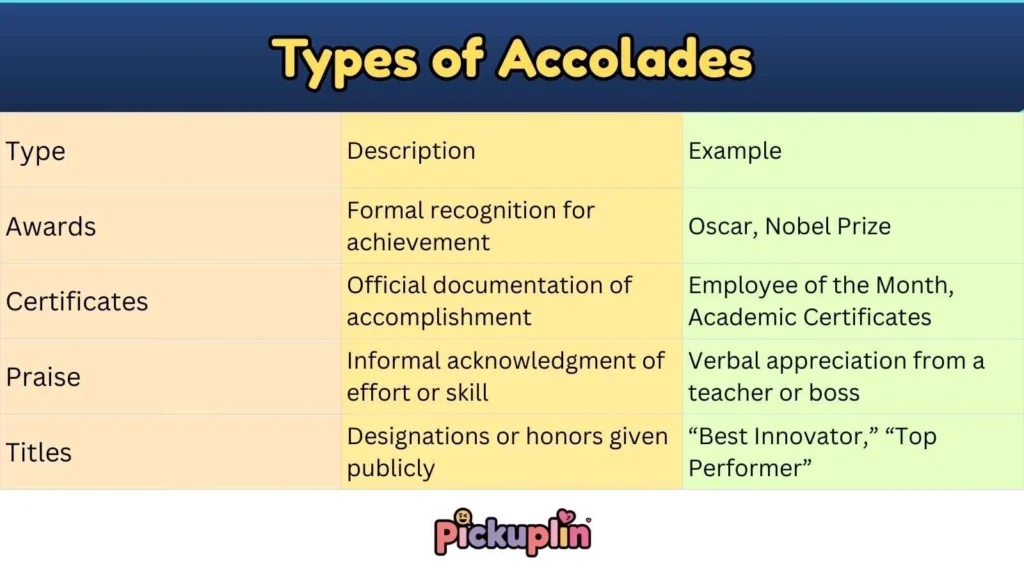
Accolades come in various forms depending on context. Here’s a clear breakdown:
| Type | Description | Example |
|---|---|---|
| Awards | Formal recognition for achievement | Oscar, Nobel Prize |
| Certificates | Official documentation of accomplishment | Employee of the Month, Academic Certificates |
| Praise | Informal acknowledgment of effort or skill | Verbal appreciation from a teacher or boss |
| Titles | Designations or honors given publicly | “Best Innovator,” “Top Performer” |
Examples of Accolades in Different Areas 🌍
Education 🎓
Students can earn accolades for academic excellence, leadership, or community service. Examples include honor rolls, scholarships, or school awards.
Workplace 💼
Employees receive accolades for outstanding performance. Common forms include employee awards, promotions, or recognition in meetings.
Sports ⚽
In sports, accolades motivate athletes. Think Olympic medals, MVP awards, or Hall of Fame inductions.
Arts & Entertainment 🎭
Artists and performers gain accolades through awards like Oscars, Grammys, or literary prizes, which recognize their creativity and skill.
How to Earn Accolades 💪
Accolades are earned through effort, dedication, and excellence. Here are practical tips:
- Set Clear Goals: Knowing what to achieve guides your efforts. 🎯
- Work Hard: Consistency is key to recognition. ⏱️
- Showcase Skills: Share accomplishments confidently. 📣
- Help Others: Contributions to community or team work are valued. 🤝
The Psychological Impact of Accolades 🧠

Accolades influence motivation, self-esteem, and mental health. Positive recognition releases dopamine, creating a sense of satisfaction and encouraging continued effort. On the flip side, lack of recognition can cause frustration or demotivation. Balancing acknowledgment is key. ⚖️
Common Misconceptions About Accolades ❌
- They Are Just for Show: False. Accolades have real impact on growth and morale. 💡
- Only Big Achievements Count: Small acts of excellence also deserve recognition. 🌱
- Everyone Receives Them Equally: They are earned, not given randomly. 🏅
Famous Accolades Examples in History 🌟
Throughout history, accolades have honored excellence:
- Marie Curie: Nobel Prizes in Physics & Chemistry 🧪
- Martin Luther King Jr.: Presidential Medal of Freedom ✊
- Michael Jordan: NBA MVP awards and Hall of Fame induction 🏀
Accolades vs Recognition: Are They the Same? 🤔
While often used interchangeably, there’s a subtle difference:
- Accolades: Formal awards, honors, or titles. 🏆
- Recognition: Broader acknowledgment, including informal praise. 🌟
How to Give Accolades Effectively 🎁
Giving accolades properly strengthens relationships and motivation:
- Be specific about the achievement ✅
- Deliver them sincerely and promptly 🕒
- Use public acknowledgment when appropriate 📢
- Combine verbal praise with tangible awards 🏅
Accolades in the Digital Age 🌐
Social media and professional platforms like LinkedIn have expanded how accolades are shared. Digital badges, endorsements, and online awards allow recognition to reach a global audience. 💻
Accolades and Career Growth 🚀
Professional accolades can open doors to promotions, networking opportunities, and leadership roles. They signal credibility and achievement, making them invaluable for career advancement. 📈
Tips to Showcase Accolades on Your Resume or Profile 📄
- Include awards in a dedicated “Achievements” section 🏅
- Use measurable results where possible 📊
- Keep descriptions concise but impactful ✨
- Highlight recognition relevant to your career goals 🎯
Accolades in Personal Life ❤️
Beyond professional or academic achievements, personal accolades like community service awards, volunteer recognition, or family honors strengthen self-esteem and social bonds. 🌸
Quotes About Accolades to Inspire You ✨
“Recognition is the greatest motivator.” – Gerard C. Eakedale
“Appreciation is a wonderful thing. It makes what is excellent in others belong to us as well.” – Voltaire
FAQs
1. What does accolades mean?
Accolades are awards, honors, or public praise given to recognize achievements or excellence in any field. 🌟
2. Are accolades only for professionals?
No! Accolades can be given in education, sports, arts, or personal life. They are about recognizing effort and success. 🎓⚽🎨
3. How can I earn accolades?
Focus on hard work, consistency, skill development, and meaningful contributions. Recognition often follows excellence. 💪
4. What is the difference between accolades and recognition?
Recognition is broader, including informal praise. Accolades are formal honors, awards, or titles. 🏆
5. Why are accolades important?
They boost confidence, motivate growth, validate effort, and enhance reputation both personally and professionally. 🌟
Conclusion:
Understanding the meaning of accolades reveals their power to inspire, motivate, and acknowledge excellence.
Whether in work, education, sports, or personal life, accolades celebrate achievement and encourage continuous growth.
By striving for meaningful recognition and appreciating the accomplishments of others, we create a culture of excellence and positivity. 🌟

I’m the voice behind Pikuplin, where I simplify meanings, slang, and everyday expressions in a way that actually makes sense. I love breaking down words and phrases so readers can understand not just the definition, but the real meaning behind them. Every piece I write is based on clarity, curiosity, and real human understanding.